
























Like what you see?
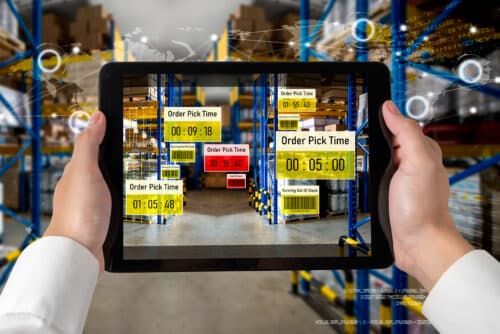
Even though we don’t often hear about industrial technology advancements unless they’re major game-changers, the world of warehouse automation technology continues to quietly evolve behind the scenes. Recent innovations in specific technology arenas have resulted in new safety and management, as well as continuous improvements to solutions that directly benefit the supply chain. In this article, we will outline several new and updated technologies that can help make your warehouse employees safer and more efficient.
The Role of Technology in Supply Chain Operations
Technology can be defined in so many ways, it can at times be very difficult to keep track of all the different scenarios we can employ technological solutions in our warehouse environments. To help set the stage for our list of solutions below, let’s briefly review three main types of technological approaches to everyday operation challenges:
- Reallocating Human Labor – automation and technological solutions find their roots in performing a task on behalf of a human worker, freeing up that employee for other duties where technological advancements haven’t yet been made. Today, a significant portion of industrial technology still serves this primary function, though in ultra-modern ways such as with self-driving vehicles.
- Automatic Intervention – human senses and intuition are nothing short of remarkable, however, augmenting natural human senses is the foundation of the safety technology industry. Aside from intervening in automatic ways where humans may find themselves at risk, all sorts of automatic processes and machinery use secondary technologies to augment their own operations as well – auto shut-down during unsafe conditions and auto error resolution are two examples.
- Using Data for Informed Decisions – you may have heard the phrase “turn data into information”, and nowhere is that truer than in industrial automation. With all the data gathered by our technological manufacturing, storage, and handling systems, processing this data into valuable decision-making information is an obvious next step. Currently, technology advancements exploit the data already in play within our warehouses to help owners increase efficiencies, decrease losses, predict both good and bad situations before they occur, and learn how to improve their businesses across the board.
Technology Solutions in Warehouse Safety and Efficiency
With the above three main roles of technology in mind, let’s dive into a list of novel ways that advanced technology solutions can help drive safety and efficiency improvements in material handling applications.
Warehouse Management Software – these sophisticated software applications provide a wide range of warehouse management and optimization solutions, increasing productivity and driving down waste in many forms. Human and vehicle traffic can be tracked and improved to decrease travel times, as well as to properly separate traffic types towards the goal of protecting pedestrians. Inventory levels and storage locations can be improved within the warehouse, cutting down on restocking labor and unnecessary product handling. Partial package and work-in-progress clutter can even be cut down through proper work planning and pick-lot assignments. Keeping floor space free of unnecessary pile hazards that almost always end up in emergency exit lanes or staging areas.
Cobots – these robotic systems are designed to work adjacent to humans, offloading repetitive and monotonous tasks so that human talent can be more aptly used in creative, problem-solving roles. This heightened engagement and job enrichment reduces accidents, burnout, and repetitive stress injuries. Cobots are more often found in manufacturing environments where they perform portions of assembly work (such as torquing screws) but are more and more moving into material handling applications such as grabbing, labeling, orienting, and positioning objects at packaging stations.
Real-Time Location System (RTLS) – an RTLS is an emerging technology that consists of position sensors deployed throughout a warehouse, and position transponders worn or carried by every employee, vehicle, and major equipment piece operating within the space. Rules and condition criteria are configured such that whenever transponders are sensed veering into undesirable proximity of each other, automatic notifications, warnings, or equipment shutdowns immediately occur. For example, if an automated forklift nears a group of employees, the RTLS can sound an audible beacon installed in the area as a warning and slow the AGV to a reduced speed. RTLS technology can also be used for employee tracking, area restriction, and immediate locating and evacuating communication in the event of an emergency.
Advanced Training Solutions – thorough and intentional training still serves as one of warehouse managers’ strongest tools for keeping workers safe on the job. We didn’t always turn to the latest and greatest technologies to call something ‘advanced’ – in many ways, using tried and true approaches in more consistent manners can make the overall application become advanced and modern, and safety training provides us with a perfect example. We believe that human-to-human safety training, conducted by an invested, experienced trainer in person and in real working environments with staff, produces the most meaningful and retained safety education. Technologies to track, confirm completion, and refresh this training over time can help busy employers ensure that no employee is left behind in this process, and we find that simple use of software on top of robust training content can provide an advanced, modern training program meeting these goals.
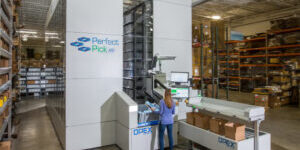
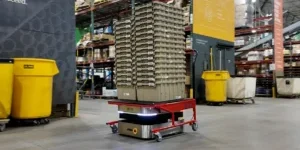
Warehouse Automation and Controls – automated material handling, conveyance, storage, and retrieval systems all serve the purpose of reducing physical labor, improving ergonomic concerns, and speeding up warehouse throughput. Material handling automation can come in near-infinite forms, from single mechanized conveyors transporting packages across the warehouse, to entire buildings full of automated robots handling materials from reception through outbound shipment.
Environmental Technologies – few would argue that the better-conditioned a warehouse is, the safer it is as well. A major factor in warehouse cleanliness is indoor air and environmental quality. In decades past, low-grade air handling equipment was routinely installed in warehouse spaces, lacking good air filtration, as well as any heating or cooling capacity. Outside air particles and pollution were pumped into employee spaces, and temperatures would swing into at times dangerously high or low ranges. As modern HVAC (heating, ventilating, and air conditioning) technologies have matured, the costs of providing air filtration and temperature conditioning for warehouse employees have dropped substantially, leading to rapidly increasing adoption. Further, modern building and labor codes have almost all uniformly advanced the case of employee environmental comfort and protection in warehouse spaces.
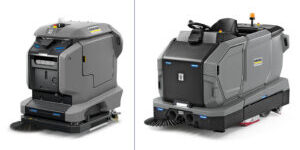
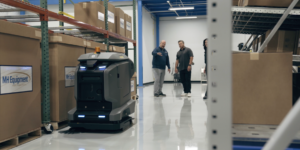
Cleaning Technologies – serving a similar goal as the environmental conditioning topic above, warehouse cleaning technologies also serve to keep warehouse areas free of debris and hazards that can pose risks to employees. Self-guided floor scrubbers, vacuums, and sweepers can navigate through a warehouse, tidying up floor soils continuously throughout the day. This is especially useful in wet or dusty climates where soils tend to get tracked into the warehouse through normal truck unloading traffic. Even better, operators can quickly assign a cleaning vehicle to a specific area if a spill or debris hazard is spotted, queuing up a cleaning vehicle via their tablet, phone, handheld, telematic, or area interface.
Wearables – wearable technologies have certainly grown in popularity in the form of smartwatches, health monitors, and even augmented reality glasses. Some technology companies are pursuing ways to expand such wearables into our work lives, claiming benefits such as monitoring employee health and wellness and receiving immediate notification of a health emergency such as a heart attack. While we recognize that such benefits may exist, deploying such technology today crosses into potential individual health care, medical condition, job fitness, and general privacy grounds that our legal system has not yet sorted through. In certain industries, the benefits may outweigh the concerns, such as with heart monitors in hazardous environments or body cameras on law enforcement. In material handling, we urge employers to fully research the legal and interpersonal elements of wearables before deploying them.
Choosing the Technology that’s Right for Your Business
How do you decide which technology is right for your business? Many companies consult with an expert in automation technology and supply chain solutions. MH Equipment offers innovative solutions, as well as consulting services to help your business be safer and more efficient. From the most current technology to the most knowledgeable team of experts, MH will aid and assist in making decisions that are right for you.
MH Equipment is one of the largest material handling service providers in the United States, with 30+ locations and over 900 employees serving customers in upper Mid-West and Eastern states. Our mission is to deliver exceptional service in material handling equipment sales, service, rental, certification & training, emergency response, and engineering. From complete fleet management to warehouse design, vehicle sales to roadside response, our local experts are here to serve your needs. For more information or to discuss your application, please call us at (308) 210-7387, visit our website here, or email us here.
Posted in Automation, News
We are here to help.
Count on our friendly support team to provide the guidance you need. (614) 871-1571
Related Posts