















Like what you see?
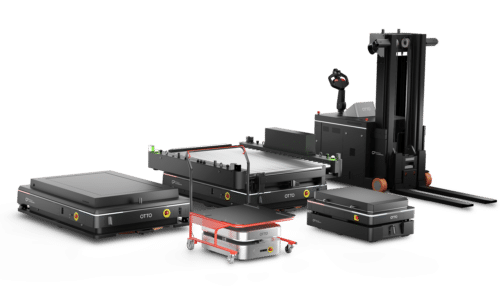
Logistics centers operate on two core metrics: throughput volume and order accuracy. A limiting factor to both of these metrics has long been tied to human labor – you can only fit so many people into a small space and expect them to be productive. Warehouses and distribution facilities embody this exact paradigm, being built out to maximize storage areas at the expense of human and vehicle traffic areas. Putting all of this together, we’re faced with a logistics design challenge, and that is how to minimize material movement space while maximizing accurate productivity within that space. The solution to this challenge might take one form when we’re solving for human productivity, but what if we had an alternative solution that could drive down the space constraints and drive-up productive capacity? Enter Autonomous Mobile Robots (or AMRs), a growing material handling technology platform that promises to solve this exact challenge. Below we’ll explore AMRs as both a hardware and software ecosystem, provide application examples, and share a few thoughts on ideal AMR deployments.
An AMR platform begins with its hardware components, consisting of small-to-large robotic vehicles that can hold and transport goods of all different sizes. In the next section, we’ll showcase the most common robot scales by their application, but ahead of that readers can visualize robots freeing up their human counterparts by taking on tasks such as:
- Delivering goods from storage zones to work cells.
- Staging containers between work stages as Work In Progress (WIP).
- Picking goods and relocating to pack-out stations.
- Transporting raw and finished goods amongst storage locations.
- Completing deliveries of consumables to pack lines.
- Returning over-draws to inventory.
Typically, humans or other robotic machinery will place goods onto an AMR’s cargo deck, and the AMR will then drive itself to its destination automatically. AMRs have quite advanced onboard navigation and positioning sensors, allowing them to operate around human workers safely while on their way. Multiple AMRs work together in a given warehouse environment, following optimized routes and traffic patterns so as to avoid conflicts, bottlenecks, inefficient distances, and long delivery times. This brings us to the software component of an AMR ecosystem – the Fleet Management suite.
An AMR Fleet Management suite is an enterprise software package that utilizes a wireless mesh network and telemetry sensors to often control hundreds of AMRs under one roof. This software is where traffic routes are programmed, analyzed, optimized, and executed. On top of traffic control, fleet management software also integrates job supervision, robot management (such as charging and health status), and facility integration functions (such as integrating co-bots, conveyors, AS/RS, and other robotic systems).
Route-Based Robotics Implementation
With the above introduction to AMR platforms out of the way, the next topic at hand concerns how to conceptualize AMRs fulfilling specific tasks. Do AMRs get programmed to simply follow a given path when a load is placed on them, or are their objectives more complex than that? Let’s answer that question by introducing the notion of selecting AMRs and their functions based on routes, much like you would design human traffic patterns.
To best showcase the route-based AMR concept, we’ll use models from OTTO Motors’ AMR lineup – readers can learn more by visiting OTTO’s website here.
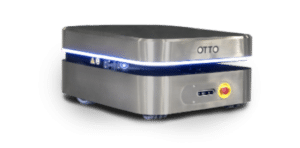 Pushcart Routes (OTTO 100 Model) Pushcart Routes (OTTO 100 Model)
Small AMRs are great for pushcart routes, delivering single or few container loads short distances, just as a human using a hand truck would do. Typically, these routes are short, out-and-back routes with loads up to 330 lbs. |
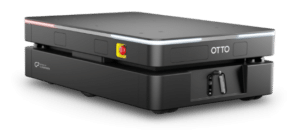 Dolly Routes (OTTO 600 Model) Dolly Routes (OTTO 600 Model)
Small order picking or medium-sized container picks typically call for a person to roll out a dolly or cart, stopping at several locations to complete their mission. Midsize AMRs are perfect for this application, carrying loads up to 1,322 lbs. |
Tugger Routes (OTTO 1200 Model)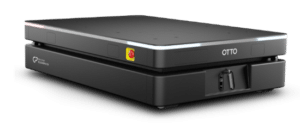
As we reach towards larger loads, heavy-duty AMRs fit the bill with capacities up to pallet-sized loads weighing 2,640 lbs. These units take the place of tugger AGVs and forklifts running routine out-and-back routes, freeing up the one- or two-person teams needed to transport goods of this size. |
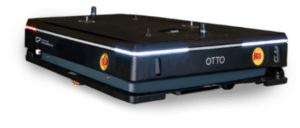
Heavy Equipment Routes (OTTO 1500 Model) For mission-critical oversized load routes, the largest flat-deck AMRs can replace rapid response forklift sprint teams with capacities up to 4,200 lbs., as well as long battery life, aggressive environment construction, fast speed, and nimble maneuverability. |
Pallet Pick and Place Routes (OTTO Lifter Model)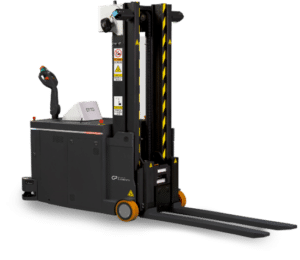
Where the above flat-deck AMRs specifically handle transportation of goods and require other means to load and unload themselves, a Lifter AMR (otherwise known as an autonomous forklift) can perform all of the above in one equipment piece. Able to lift 2,640 lbs. pallet loads and travel briskly at 3.4 mph, lifter AMRs can replace an entire full shift forklift operator’s route. |
The AMR units above are just the beginning – robots are routinely outfitted with all types of attachments, accessories, carry decks, cages, shelves, and so on, specifically configured to serve the needs of each individual application.
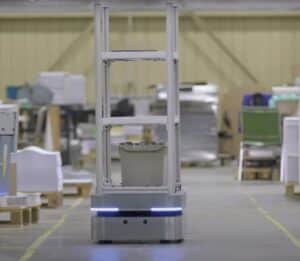
Fig. 1 – AMR with Attached Rack
It may be important to distinguish between AMRs and AGVs: the latter are Automated Guided Vehicles and have been around a bit longer. Many of our partner manufacturers offer excellent options in AGVs, though you’ll find the applications are somewhat narrower. AGVs may be considered an intermediate step as they’re better suited for fixed “point A to point B” routes and simpler workflows. As you’d expect, the two solutions differ significantly in required investment. More on the differences can be explored here.
AMRs Work Best at Scale
Over the last twenty years, most of the talk around automated material handling has been in either AS/RS storage cells (automated storage and retrieval systems) or in AGVs (automated guided vehicles). Both of these technology platforms are rooted in the word ‘automated’, meaning that routes and functions are programmatically assigned and predetermined. Instead of manual human motion, vehicles and carts follow automated paths from point A to point B. Today’s innovations are in ‘autonomous’, not in ‘automated’, meaning that hardware solutions are in some ways making their own decisions and carrying out their own routes, based on the autonomy provided to them by their programming. This is the difference with AMRs, where the ‘A’ is intentionally ‘autonomous’ and not ‘automated’.
Since AMRs have this selective discretion over guiding their own functions, we can begin to understand how buzzwords like ‘machine learning’ might apply here and not just be another marketing gimmick. AMRs can be deployed with complex expectations and limited hard-coded programming, making them easier to deploy and more cost effective to work around real-life, never-perfect industrial operations. Investing into such a platform does of course have a cost, and a number of corporate hurdles to overcome such as business operation design, cybersecurity, risk and performance responsibility assignment, and cost benefit gradients over time. This also means that once the investment decision is made, AMR platforms are ideal to deploy at scale, trading large-breadth manual human labor for autonomous robot labor, and then pulling those human resources back into more valuable functions within the business for an overall net gain.
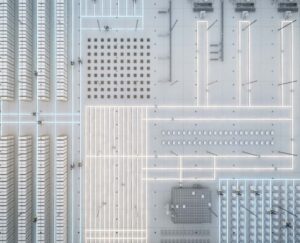
Fig. 2 – Large-Scale AMR Deployment and Routes
Overall, this tells us that AMRs fit best into material handling and supply chain applications that are at scale, currently heavily human dependent, limited by labor and space availability, and prone to disruptions related to how these factors play out on a daily basis. Medium to large distribution centers, commercial and industrial manufacturing facilities, last-mile storage and staging centers, e-commerce centers, and general warehouses are all great applications that could benefit from AMR systems.
MH Equipment is one of the largest material handling service providers in the United States, with 30+ locations and over 1,000 employees serving customers in upper Mid-West and Eastern states. Our mission is to deliver exceptional service in material handling equipment sales, service, rental, certification & training, emergency response, and engineering. From complete fleet management to warehouse design, vehicle sales to roadside response, our local experts are here to serve your needs. For more information or to discuss your application, please call us at 309-579-8020, visit our website here, or email us here.
Posted in Automation, News
We are here to help.
Count on our friendly support team to provide the guidance you need. (614) 871-1571
Related Posts