





















Like what you see?
Getting higher capacity out of your supply chain facility is about much more than just physical size. As we see it, utilization of a warehouse involves four dimensions – the standard three physical dimensions front to back, side to side, top to bottom, and the fourth dimension of time. Since time is a dimension that we can only influence in the future, it has a predictive nature to it, which is to say that getting more out of a given space is rooted in how well we can orient that space towards expected future needs. We can certainly change the layout and equipment in our warehouses, but will that be enough to stay competitive? Most likely not.
Automated systems and technology platforms provide a powerful shortcut toward using space in the most efficient manner possible, while simultaneously optimizing for the predictable needs of tomorrow. In this article, we’ll discuss how warehouse managers can put automated technologies to work towards maximizing a facility’s utilization by solving in all four dimensions.
The Opportunities of Automation
Before jumping into examples of automated material handling solutions, let’s first understand the main attributes that automation looks to address. In other words, what specific constraints can automation directly relieve in your warehouse?
- Space Allocation – automation directly provides more usable space in a warehouse by replacing unused traffic space with functional storage or conveyance equipment.
- Inventory and Handling Errors – automation provides real-time, high-integrity analytics and computational power that can drastically improve inventory and order fulfillment issues.
- Safety – lost-time accidents and near-miss events can be greatly reduced by automation that leads to separating employees from warehouse equipment while also cutting overall congestion.
- Bottlenecks – workflow upsets that result from fulfillment or production bottlenecks can be smoothed out by automated systems through preemptive control of work tasks, materials, and equipment.
- Labor – automation can mechanize physical labor and digitize data entry work in ways that free up employees to be used on other more creative, decision-making tasks.
- Communication – the use of automated systems cuts the need for analog communication between humans drastically, which both eliminates common miscommunication points and completes work sequences faster.
- Operating Uptime – automated systems can operate around the clock, increasing warehouse throughput across shifts or weekends that were not previously staffed.
Now that we know a bit more about the specific objectives that automation can achieve, next we will run through three key opportunity areas in applying automation to your material handling facility: space, efficiency, and overall utilization.
Maximizing Space
For argument’s sake, let’s assume we have already optimized our pallet and case build configurations, added racking and shelving in all available floor space, and have built up vertically as high as we can go. To increase our warehouse’s capacity without adding building area from here, all we’re left to work with then is the space between pallets and containers. With traditional single-deep pallet racking, we can potentially reduce the clearances around a pallet as well as the top lift-off clearance, but we still need ample unused floor space around the racking for traffic circulation and access. There is a risk of reducing the clearances around a pallet so much that we sign up for impacts and damage, so this option only gets us so far. Once we have squeezed as much available space out of traditional racking as possible, the next step is to explore higher-density storage racking and automated solutions, such as:
- Replace selective pallet racking with semi-automated, deep lane pallet runner racking, gaining more usable floor space dedicated to pallet storage with fewer forklift aisles.
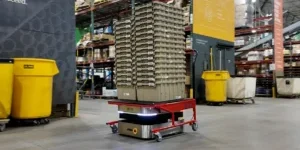
- Utilize Autonomous Guided Vehicles (AGVs), forklifts, and order pickers that can automatically traverse warehouse spaces, pick orders, and transport goods within much smaller travel aisles than traditional manned forklifts.
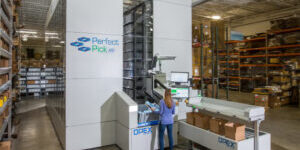
- Further improve capacity by installing a fully automated, high-density Automatic Storage and Retrieval System (AS/RS), which uses conveyors and robotics to store and move goods, eliminating forklift aisles within the storage area entirely.
Maximizing Efficiency
Next, let’s look closer into the fourth dimension we introduced earlier: time. Once we’ve maxed out storage density using the approaches mentioned above, we can still gain the equivalent of physical space by improving the efficiency of our material handling workflows. For example, if our pick rates are low, we are indirectly limiting how much product we can route through the facility in a given day. Improving our pick efficiency can translate into fewer errors and delays, more completed orders, and therefore more daily throughput from the same warehouse space. The net effect is the same as if we had added more warehouse square footage and operated it at the prior low efficiency. Ways that efficiency and throughput can be gained include:
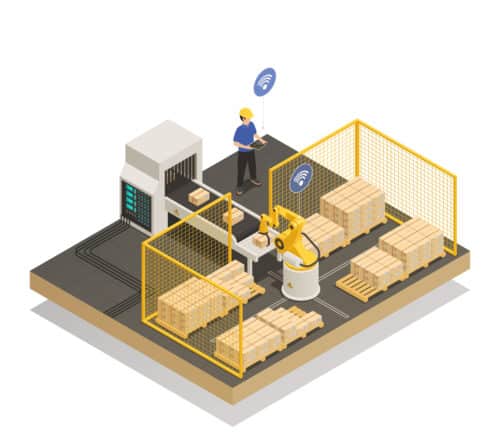
- Add automated equipment for laborious or error-prone tasks, such as material conveyors, case erectors, palletizers, and wrappers.
- Utilize automated Quality Control equipment to address major time delays, such as automatic pallet swappers where low-quality pallets are causing conveyor stoppages.
- Anywhere that operators are waiting for instruction or decisions, automated software solutions can be excellent improvements towards overall efficiency. Inventory databases, order management dashboards, and even pick-task augmented reality systems are great options.
Maximizing Utilization
Optimizing individual tasks to gain efficiency will bring great capacity increases, but there is one more level available towards fully maximizing your facility’s effective space. Full facility utilization is the measure of how well you are putting your physical space to use over a long period of time and is a primary metric used to measure the strength of businesses against each other.
Let’s consider a test case. Business A and Business B both have 10,000 pallet warehouse capacities of similar goods, operate three shifts over 7 days per week, and have the physical capacity to move 100 pallets per hour.
Business A struggles with slow truck loading times, a noticeable amount of non-moving storage positions, and difficulty with accurate inventory control over a year’s time. Due to these constraints, the facility is only able to achieve an 80% utilization rate – no matter how efficient they make individual tasks, the overall capacity of the warehouse “feels” lower because of these inherent limitations.
In contrast, Business B has invested in several automation solutions with the strategic goal of solving overall utilization. These platforms include:
- Inventory Management System (IMS) – this system identifies slow-moving products as well as imbalances between raw and finished product volumes and advises Operations of necessary decisions to optimize inventory levels.
- Warehouse Management System (WMS) – this system actively manages all order missions ahead of crunch time, moving pallets to staging positions close to the truck docks, coordinating fork truck operators and their paths via HUD screens on their lifts, and automatically transmitting paperwork.
- Fleet Management System (FMS) – this system is used to coordinate Warehouse vehicle traffic, pre-load trailers, and park in the yard plus text the rig driver to the trailer’s location automatically, and even schedule predictive vehicle maintenance to avoid unexpected downtime.
Overall, Business B is able to consistently hit a utilization rate of 92%, which translates into more shipped orders, inventory turns, and higher total throughput in the same physical space, all thanks to advanced automation solutions.
MH Equipment is one of the largest material handling service providers in the United States, with 30+ locations and over 900 employees serving customers in upper Mid-West and Eastern states. Our mission is to deliver exceptional service in material handling equipment sales, service, rental, certification & training, emergency response, and engineering. From complete fleet management to warehouse design, vehicle sales to roadside response, our local experts are here to serve your needs. For more information or to discuss your application, please call us at (308) 210-7387, visit our website here, or email us here.
Posted in Automation, Services
We are here to help.
Count on our friendly support team to provide the guidance you need. (614) 871-1571
