























Like what you see?
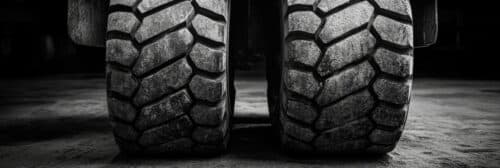
In any given industrial environment, forklifts pose three main operational risks: striking pedestrians, impacting goods and fixed infrastructure, and harming operators. All three of these risk factors are equally influenced by the operator driving the forklift as well as the condition of the forklift itself; however, there is one common element between them—the forklift’s tires.
A forklift’s ability to properly maneuver is only as good as the contact the lift has with the ground. Healthy forklift tires provide ample traction, agile steering, and responsive braking, whereas unhealthy tires can make a forklift unstable and unsafe to drive. On top of damaged and worn tires being a major risk, aggressive driving behavior makes matters even worse. As such, a forklift’s tires can be viewed as the last line of defense against the above risk factors, making proactive tire maintenance and replacement a vital component of overall warehouse safety.
Keeping an Eye on Forklift Tire Wear & Tear
Here are the most common indicators of potentially risky forklift tire wear that operators and fleet managers must look out for:
- Tire Wear Rules of Thumb: Each of the different forklift tire designs comes with a rule of thumb that communicates when a tire is due for replacement. For solid tires, the rule of thumb is to replace a lift’s tires once the internal wear band becomes visible. For cushion tires, the rule of thumb calls for tire replacement once the tread depth has worn down to the top of the factory lettering written on the tire’s sidewall.
- Surface Wear: General wear and tear of forklift tires will ideally present as evenly worn tread with the tire’s materials still appearing elastic and firm but not brittle. Some minor surface knicks may be present in where the tire meets the ground (not in the sidewall or valleys between tread knobs). When this ideal wear pattern is present, fleet managers need only continue to monitor conditions and plan for eventual replacement. If there is wear on the sidewalls, between the tread knobs, or the material is becoming brittle, it is time to consider replacing the tires.
- Flat Spots: Flat spots in forklift tires are portions of the tire that lose their rounded radius. This can be caused by the lift sitting for extended periods of time, aggressive maneuvering, abrupt stopping that skids the tires, or excessive weight overloading. These flat spots result in uneven weight distribution and bumpy movement, requiring replacement.
- Debris Impaction: Operating a lift on surfaces littered with foreign debris can lead to traction loss and is dangerous enough, but it is even worse when such debris becomes embedded into a tire’s surface. Beyond causing uneven tire rotation and poor ride comfort, debris impaction can cause solid tires to fracture and pneumatic tires to leak air or rupture.
- Uneven Wear: Just as with automobiles, uneven wear on tires can cause a forklift to pull to one side, experience unequal traction, and cause premature tire failure. Uneven wear can be due to driving habits, unevenly distributed loads, forklift misalignment, or improper pneumatic tire inflation.
- Discoloration: Forklift tire discoloration is usually caused by excessive UV (sun), chemical, or temperature exposure. Under such conditions, both natural and synthetic rubber tires suffer damage at a compositional level, and discoloration can be an early sign of damage that may result in tire failure.
- Age: Even when a tire’s outward appearance seems unremarkable, all forklift tire materials degrade over time. Older tires lose their elasticity, become stiff, lose surface material, and experience an overall increase in their risk of failure. One of the first signs of an aging tire is a decrease in ride comfort; in the case of pneumatic tires, slow air leaks can be an indicator as well.
- Visible Damage: Forklift tires naturally take a large amount of abuse during standard operation, but it should never be considered normal for tires to possess visible signs of damage of any kind. Missing traction knobs, cracks, cuts, divots, and bulges must all be taken as signs of impending failure. More dramatic damage that must be addressed at first sight would be tire blowouts, bond separation, and radial cracking, which usually indicates overloading, excess duty cycles, or incorrect tire selection.
Tips for Worn Forklift Tire Maintenance and Replacement
Given how critical forklift tires are to warehouse-wide safety, the importance of tire maintenance cannot be understated. In this way, we recommend that forklift fleet managers employ a two-part approach, the first part being active preventative maintenance management and the second being first-indicator replacement. Let’s explain both below.
Preventative Forklift Tire Maintenance Management
At a high level, forklift tire maintenance is straightforward: inspect tires for any of the above signs of looming failure. If any are discovered, tag the lift out until the suspect tires can be replaced and the underlying cause of the damage is identified.
With that said, there are more detailed maintenance activities that managers can direct to maximize forklift tire life. Beyond inspections, forklifts should receive frequent tire cleaning, tire pressure adjustment, hub and steering lubrication, removal of any embedded debris, and—for applicable lifts—rotation, alignment, and balancing.
The concept that we’re laying out here is that while tire maintenance itself is a limited exercise, management of tire maintenance presents the greatest opportunities. Fleet managers must ensure that inspections and regular service intervals are actually occurring, and they must raise the conversation within the organization where needed when risky conditions are discovered. This might take the form of scheduling reinforcement training (such as when inspection renders signs of aggressive driving) or deep warehouse floor cleaning (such as when a high volume of embedded debris is found). In all cases, managers must take tire symptoms as signs of undiscovered risks elsewhere and work proactively to resolve the root cause before it becomes a larger, fleet-wide issue.
First-Indicator Forklift Tire Replacement
On the other side of the forklift tire maintenance coin is knowing when and how to replace a tire as a function of protecting overall warehouse safety. Simply put, fleet managers must be willing and able to call for a tire’s replacement upon the first reasonable and objective indication that the tire poses a risk to the warehouse. Too often, organizations skirt the line between responsible service frequencies and cost avoidance that—in the case of forklift tires—leads to forklifts operating with compromised tires well past their first indication of pending failure.
With this in mind, we implore fleet managers to adopt the principle of first-indicator replacement. Under this principle, managers are motivated to call for a forklift tire’s replacement upon the first indication of any problem, no questions asked. There is too much at risk gambling on a suspect tire’s suitability to justify the marginal cost savings of waiting it out. Once initiated, a professional service company or the warehouse’s internal maintenance team should replace the tire following the OEM’s service manual and only using approved, compatible tires produced by reputable manufacturers. By doing so, warehouses stand the greatest chance of averting forklift tire-related accidents.
MH Equipment is one of the largest material dealers in the United States, with 30 + servicing locations and more than 1,000 employees serving customers in 10 upper Midwest and Eastern states. Our mission is to deliver exceptional service in material handling equipment sales, service, rental, certification & training, and engineering. From complete fleet management to warehouse design, vehicle sales to roadside response, our experts are here to serve your needs. For more information email us here.
We are here to help.
Count on our friendly support team to provide the guidance you need. (614) 871-1571
