

















Like what you see?
Forklift Safety and Productivity: Complementary Goals in Industrial Material Handling
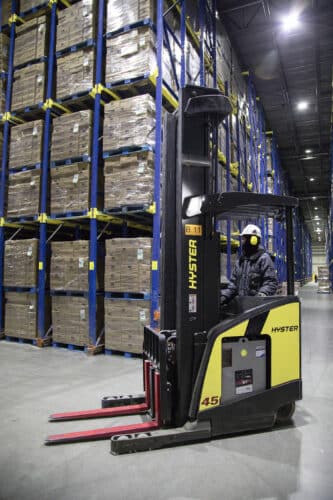
We once worked with a fantastic warehouse manager who would frequently tell her staff that “going fast doesn’t always mean going home”. Her meaning was clear: cutting corners and taking risks just to get things done quicker greatly increases the chance of accidents – accidents that can send an employee to the hospital instead of home, or worse. We’ve often thought back to this phrase and the message behind it. It reminds us to urge warehouse staff to consider that safety and productivity are not mutually exclusive but are in fact complementary goals. Of all warehouse staff, forklift operators tend to be the ones who benefit from this perspective the most, as the risks associated with forklift accidents can be severe. Luckily, there are many modern forklift design features that bolster both safety and productivity equally. By actively reinforcing this message to their staff and making deliberate equipment selections that include modern safety features, warehouse managers can help their employees understand that going home is much more important than going fast.
Getting Specific – How Forklift Safety and Productivity Correlate
In abstract, we all generally understand how safety and productivity may be two sides of the same coin, but let’s get specific. Safe forklift operations are rooted in having experienced, competent operators performing sensible tasks in a controlled environment using reliable, sound equipment. Productivity is the measure of how much work can be successfully accomplished in a given period of time.
Putting these ideas together, forklift operators can be more productive the faster they work and the more pick missions they complete. However, increasing productivity will naturally reach a point where it becomes unsafe. In such cases, forklift operators begin to make risky decisions such as exceeding speed limits, overloading their lifts, maneuvering too quickly, and breaking other safety protocols.
For this reason, the job of warehouse managers becomes keeping their operators focused on working safe as their first priority, and then pushing up productivity to match this safety threshold. From there, managers can tap into modern forklift design features and technologies to augment their operators’ safety-related actions, using these design features to make it easier for operators to stay safe to begin with. In this way, operators focus on safety first, and their lifts make it easier to be safe, together boosting productivity as a result.
Modern Forklift Design Features that Improve Safety & Productivity
How exactly can forklift features boost safety and productivity in equal measure? Let’s answer this question by using specific technology examples:
- Dynamic Stability – forklift stability is perhaps the most significant risk factor involved between safe and productive lift operations, as driving too brashly when trying to be quick can instantly result in dropped loads, pedestrian strikes, and tip-overs. Forklift features that control a lift’s stability therefore can directly reduce these risks. A great example of this technology is found in Hyster’s Dynamic Stability System (DSS) platform, which automatically controls a lift’s speed, traction, tilt, and maneuvering rates to maintain a stable center of gravity at all times.
- Visibility & Awareness – as warehouse congestion and load sizes continue to increase over time, forklift visibility becomes more important and allows operators to drive up to speed limits, react sooner, and be certain in their maneuvers. Newer forklift models have improved both operator and pedestrian visibility in novel ways, such as with Yale’s Awareness Solutions that include minimized masts and cage columns sizes, wider coverage task lighting, and prominent alarms and beacons.
- Ergonomics – forklift safety is often thought of as occurring ‘outside’ of the lift, but safety extends into the forklift cab in the form of ergonomics as well. Superior ergonomic lift cabs can be operated for longer durations and with less physical distraction to the operator. For example, Hyster forklifts include multiple ergonomic design features that defend against operator fatigue and injury such as comfort posture seating, mirrors positioned closer within an operator’s peripheral vision, and controls mounted closer to and slightly lower than an operator’s natural arm resting position.
- Telematics – data analytics is the name of the game in modern material handling, and this extends to forklift operations via telematics. In a nutshell, telematic systems combine on-lift sensors and interfaces with off-lift computational platforms that together monitor, analyze, and optimize a forklift’s operations. Telematic systems such as Hyster’s Tracker platform can automatically interact with a single lift operator or the entire fleet at once, coordinating activities and avoiding unsafe scenarios.
- Virtual Training – operators are best trained in controlled, low-risk environments, affording them the leeway to learn their lifts and tasks at their own pace. As we can see with Yale’s virtual training ecosystem, Virtual training is a new way to achieve this goal, providing operators with simulated, digital training environments using real physical controls.
- Robotic Lifts – if warehouse safety is predominantly a function of keeping humans safe, what better way to achieve this than to remove humans from risky scenarios entirely? This is one of the many goals of robotic platforms such as Yale’s robotic forklift technologies, which utilize automated, non-manned lift equipment to complete pick missions while humans are safely kept off the warehouse floor.
MH Equipment is one of the largest material dealers in the United States, with 34 servicing locations and over 1,000 employees serving customers in 10 upper Midwest and Eastern states. Our mission is to deliver exceptional service in material handling equipment sales, service, rental, certification & training, and engineering. From complete fleet management to warehouse design, vehicle sales to roadside response, our experts are here to serve your needs. For more information email us here.
We are here to help.
Count on our friendly support team to provide the guidance you need. (614) 871-1571
