




















Like what you see?
Forklift Tracking in Warehouses
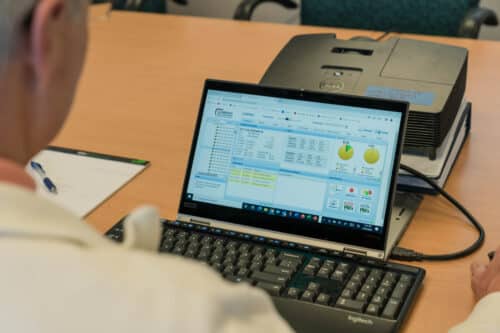
‘Forklift Tracking’ is one of those phrases that can mean a myriad of different things, all depending on the person, environment, and industry using it. Sometimes the phrase provides an answer to functional questions like “who’s currently on Forklift Number 4?”, and other times to managerial questions such as “what’s the productivity rate of our forklift fleet in Iowa?” For the sake of this article on forklift tracking in material handling centers, let’s set a clear definition: forklift tracking is combined hardware and software management system that provides performance and cost insight into forklift assets (including the lift itself as well as related personnel, parts, and workflows).
This might sound complex, and it certainly can be, but we can break it down further into key components that will make it much easier to understand. The main functional parts of forklift tracking are as follows:
- Forklifts – these are the actual forklift vehicles themselves, of any age, style, design, fuel type, and use.
- Telematics Hardware – an onboard system integrated into the actual forklift which captures real-time functional, performance, and operator data, reporting this back to the software system described below.
- Telematics Software – the above hardware transmits data from a forklift back to this software package where per-lift data is stored. Here we can see the raw data and information related to each lift, such as operating hours, operator uptime, charging time, system health, and maintenance notifications. However, to start to put this information into real enterprise-wide use, we need the last item below.
- Forklift Fleet Management Software – this software marries up the above per-lift data against management-level data, such as operating costs, maintenance requirements, corporate key performance indicators (KPIs), and other major decision centers.
Altogether, the above elements combine to form a proper Forklift Tracking system in which field data is translated into analytical information, which in turn directly feeds business decisions. At its highest level, Forklift Tracking as a model answers questions such as:
- What is the Total Cost of Ownership of my forklift fleet?
- Where are my fleet’s bottlenecks and risks?
- Where are my fleet’s opportunities to improve?
- Where and how can I drive better fleet KPIs?
- What tactical decisions do I need to make to avoid looming issues right now?
- What strategic decisions do I need to make to optimize fleet performance long term?
With some systems, the hardware and telematics components can be replaced with manual data entry, however, this method is prone to inaccurate data. We point this out to say that the heavy lifting in Forklift Tracking solutions is the decision-support software component, and users can certainly start with the software and still see improvements in their workflow. Ideally, Forklift Tracking would be implemented using all of the components mentioned above.
Benefits of Forklift Tracking for Asset Management
Now that we know what Forklift Tracking entails, let’s take a deeper look into the benefits by breaking them down into Asset and Operational domains, starting with features that speak directly to the forklift asset and its ownership:
- Consolidate Asset Records – a formal tracking system can serve as a convenient repository for all records, manuals, service logs, work orders, and other documentation.
- Maximize Uptime – looking into the use profiles of individual lifts and their operators, managers can determine all sorts of ways to maximize lift uptime.
- Optimize Charging Scenarios – real charging cycle data can be invaluable when sorting out ideal charging scenarios (in concert with uptime-related decisions mentioned above), as well as evaluating technology and fuel source differences between lifts to find actual best performers.
- Understand Avoidable Maintenance – avoidable maintenance is service scenarios that could have been predicted and addressed before they turned into downtime-causing interruptions. Documenting such situations, while also comparing conditions to OEM maintenance requirements, can provide a clearer picture into avoidable maintenance situations.
- Plan Preventative Maintenance – building on the above item, proper Forklift Tracking allows planning for maintenance needs against industry-standard metrics and backward-looking responses to issues experienced in the past. Together, this data can be used to formulate a complete preventative maintenance program.
- Spare Parts – robust Forklift Tracking helps plan, order, and stock the right mix of spare parts. You do not want to be caught waiting for long-lead parts to arrive after being hit with unexpected maintenance or overinvesting in spare inventory that you’ll never use.
Benefits of Forklift Tracking for Operational Management
Zooming out from the forklift asset level, the higher-order benefits of Forklift Tracking technology are found in supporting, informing, and even making enterprise-level decisions surrounding forklift fleet use, costs, risks, and opportunities. Such benefits include:
- Automate Fleetwide Decisions and Communication – at its core, Forklift Tracking solutions are robust reporting tools, which can pump out clear, concise, effective reports that can drive enterprise-wide communication and information sharing.
- Forecast Cost Centers – nothing can more accurately predict repeat future cost burdens than seeing where, how, and why those costs occurred in the past. Using historical data and sophisticated statistical models, Forklift Tracking systems can forecast upcoming costs early enough for you to hedge against them proactively.
- Promote Safety – poor safety management results in real harm to real people. A proven way to promote safe forklift operation is to base safety training, compliance, and investment on actual data, ranging from monitoring real-time safety metrics to having a forensic accounting of accidents so that they can be avoided in the future.
- Manage Rental Contracts – Forklift Tracking helps manage rental units in your fleet, assuring that complete rental costs, durations, return dates, and issues experienced are all fully understood. This information is especially useful in negotiating new rental contracts and terms.
- Perform Quantitative Fleet Analytics – while we trust most managers’ gut feelings, having quantitative decision information derived from real-time, complete field data provides infinitely greater assurance in a given business analytical process, making for much higher confidence in charting a path forward.
- Determine Total Cost of Ownership – the pinnacle of Forklift Tracking technology is to provide highly accurate Total Cost of Ownership data for your forklift fleet. Roughly speaking, the initial purchase price of a forklift is less than 20% of its total cost to own, meaning that most of the money (80%+) you will spend on a lift is consumed after purchase. Having this information – in real dollars charted against real expected timelines – is invaluable for informed business management, no matter if your fleet spans one or one thousands lifts.
MH Equipment is one of the largest material handling service providers in the United States, with 30+ locations and over 900 employees serving customers in 10+ upper Mid-West and Eastern states. Our mission is to deliver exceptional service in material handling equipment sales, service, rental, certification & training, emergency response, and engineering. From complete fleet management to warehouse design, vehicle sales to roadside response, our local experts are here to serve your needs. For more information or to discuss your application, please call us at (308) 210-7387, visit our website here, or email us here.
Posted in Services, Uncategorized
We are here to help.
Count on our friendly support team to provide the guidance you need. (308) 382-3585
