

















Like what you see?

OSHA’s Safety Requirements governing forklifts and powered industrial trucks covers three categories, which are:
- Training and Certification Requirements – this body of OSHA code covers standards that employees must meet in order to legally operate a forklift.
- Operational Requirements – once certified, operators and owners have additional requirements to meet during the ongoing use of a forklift.
- Application-Specific Requirements – certain operating conditions and applications come along with unique risks, and these requirements help protect employees exposed to such conditions.
For your later reading pleasure, you may choose to glance at OSHA’s extensive body of standards found in the Code of Federal Regulations (CFR) Section 1910. Forklift requirements applicable to manufacturing and distribution industries are covered in the Material Handling and Storage Subpart N, Section 1910.178. OSHA also has specific sections for forklift use in highly specialized industries such as Marine Terminals Section 1917.43 and aboard Maritime Vessels Section 1918.65. Be sure to look up the specific code sections applicable to your industry and applications, as well as any state-level requirements (many states have their own local OSHA standards).
Training and Certification Requirements
According to OSHA, anyone intending to operate a forklift in the workplace has to complete a training and certification process, made up of the following steps.
Written and Physical Test
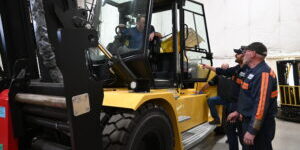
OSHA starts out new operators with a prescribed training schedule, made up of a healthy set of truck-related and workplace-related topics. Training can be performed by an OSHA-approved third party, or by your employer should they have invested in developing their own training program. A written exam is then taken to gauge the student’s understanding of the training material, and once they pass the written portion, they’re clear to receive a hands-on test using a forklift. A certified trainer will conduct the physical test, running the trainee through an assortment of call-and-response challenges and real application scenarios until the trainer is satisfied that the trainee has proven their competence on the lift.
Certification
With the training and physical evaluation complete, an employee is eligible to receive their Forklift Operator Certification. This certificate typically takes the form of a card that an operator can carry on them to prove active certification, as well as a digital and printed certificate that can be filed away. Certification documents must be dated and signed by the certifying agent and must be available for OSHA or third-party audits (insurance companies especially).
Ongoing Retraining
Just like your state driver’s license must be renewed periodically, all forklift operator certifications must also be renewed to remain active. OSHA stipulates that each operator must be reevaluated at least once every three years. Beyond this three-year anniversary, there are other conditions that could trigger retraining such as when:
- An operator has been observed to operate the vehicle in an unsafe manner.
- An operator has been involved in an accident or near-miss incident.
- An operator has received an evaluation that reveals a history of unsafe operation.
- An operator is assigned to a different type of lift truck from that which they were trained on.
- A condition in the workplace changes in a manner that could affect safe operation of the truck.
Operational Requirements
Obtaining certification is only the beginning of a forklift operator’s engagement with OSHA safety requirements. Next, we’ll discuss a few key ongoing requirements that employers and employees must satisfy.
Vehicle Inspection and Maintenance
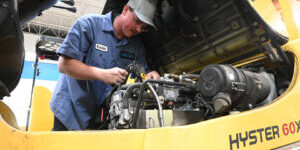
A forklift is only ever as safe as the sum of all of its parts, and performing routine inspection and maintenance work on each lift truck is the only way to be sure it’s in safe operating condition. OSHA goes so far as to codify as much right in their standards (Section 1910.178(q)). Employees are responsible for performing a pre-shift test, and should anything not be operating correctly, to tag the lift out of service until it receives maintenance attention. By the same token, employers are required to see that the maintenance work occurs whether by in-house technicians or via a third-party company. If maintenance is not occurring per the manufacturer’s requirements (or to address any known operational issues) and is left in service, the employer is in violation of OSHA standards.
Daily Forklift Checklist
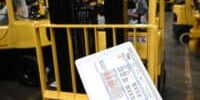
Building on the above item, OSHA requires that all forklifts be examined at least once a day or shift before use by a procedure known as a Pre-Operation Inspection. This practice requires that operators perform a visual and functional test of the lift’s systems, documenting their results in a physical or digital checklist. The goal here is to make sure that the lift is being checked for safe functionality before each use, and that the operator has assured themselves that their lift truck will get them safely through the day. If any circumstances make the operator feel uncertain about the lift’s safety during this check, the operator must remove the lift from service.
Safe Normal Operation
So far, we’ve focused on OSHA’s safety standards involved before and leading up to actual lift operation. Now we’re ready to get the lift out into the warehouse for today’s tasks, and here is where a whole new series of requirements comes into play. OSHA requires that operators understand all necessary procedures, precautions, and safe handling practices involved with performing their jobs (and on the specific lift they’re operating). Load centering, load securing, center of gravity influences, load stabilizing, vehicle safety and signaling functionality, clearances, on and on – whatever knowledge and skills that are required to safely discharge one’s duties, OSHA requires that operators know and practice them at all times.
Application-Specific Requirements
Not all forklift applications are created equal, which goes without saying. Even still, OSHA requires operators to be informed about hazards and unique conditions that they may face in their respective companies.
Unique Working Environment Consideration
Each workplace has its own set of unique considerations that forklift operators must know in order to discharge their duties safely. To the degree that topics overlap, OSHA requires that workplace safety training and practices complement each other. For example, pedestrian workers should receive forklift hazard awareness training, and be provided with dedicated walking aisles separate from forklift aisles. In addition, forklift operators should receive ample provisions to defend against similar external hazards, such as appropriate protective attire when working in a frozen storage environment.
Specific Hazards of Interest
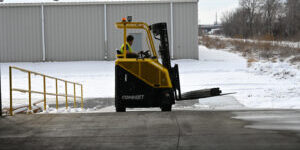
Some workplaces involve hazards of such magnitudes that they involve additional technical training, special lift truck equipment, dedicated OSHA regulations, or a mix of all three. Cargo handling with powered industrial trucks at marine terminals is one such case, where lifts are typically very large and operate in proximity to extreme potential dangers (driving off a dock edge, exposure to severe weather, etc.). Handling combustible materials, working on outdoor construction sites, and using a lift near live electrical gear are other examples of specific hazards that call for enhanced safety.
General Duty Clause
With as much as the above discussion lays out specific provisions that employers shall take to ensure safe forklift operations for their employees, OSHA by no means provides an exhaustive list of requirements covering all industries, applications, and hazards. Ultimately, OSHA requires that employers provide safe workplaces, and in the event that an accident occurs which has no governing code requirement in place, OSHA can still assign fault to the employer via the General Duty Clause. We share this to say that employers and employees cannot rely on OSHA to spell out every safety requirement needed to maintain safety, and it falls to each of us to be responsible for our own wellbeing. Employers will violate the General Duty Clause when:
- The employer failed to keep the workplace free of a hazard to which employees of that employer were exposed.
- The hazard was recognized.
- The hazard was causing or was likely to cause death or serious physical harm.
- There was a feasible and useful method to correct the hazard.
MH Equipment is one of the largest material handling service providers in the United States, with 30+ locations and over 900 employees serving customers in upper Mid-West and Eastern states. Our mission is to deliver exceptional service in material handling equipment sales, service, rental, certification & training, emergency response, and engineering. From complete fleet management to warehouse design, vehicle sales to roadside response, our local experts are here to serve your needs. For more information or to discuss your application, please call us at (308) 210-7387, visit our website here, or email us here.
Posted in Safety, Uncategorized
We are here to help.
Count on our friendly support team to provide the guidance you need. (614) 871-1571
