

















Like what you see?
Solving Warehouse Challenges with Specialty Fork Trucks
At a certain point, the technologies used to handle common applications become the “standard” or default solution accepted across an industry. In material handling applications, traditional forklifts have certainly become the standard for moving pallets and large loads around a warehouse. The problem is, once these default solutions are entrenched, new technologies have a tough time garnering attention even when they display clear advantages over established standards. A current example of this condition involves Specialty Fork Truck Equipment, which is a category of material handling equipment based on fork trucks but with unique benefits, capabilities, and technical design features.
What sets Specialty Fork Truck Equipment apart from standard forklifts? Three things:
- Unique Design – specialty forklifts share a resemblance to standard forklifts but offer significantly enhanced benefits for specific applications. These unique design features may include how the lift maneuvers, how it picks and places loads, or how large and heavy of loads it can handle relative to its footprint.
- Compatible Warehouse Design – specialty fork truck equipment directly allows for higher optimized warehouse designs over traditional forklifts, including narrower aisles, tighter maneuvering intersections, and even completely turn-free, linear layouts.
- Special Operating Requirements – specialty lift operators must be specifically trained on these new lift types, as they are different enough from standard forklifts that they require heightened awareness of their safety, stability, and risk elements. This is not to say that specialty trucks are more difficult or riskier to operate than standard forklifts – only that they are different enough that special training is necessary.
Specialty Forklift Types
Let’s have a look at the main types of specialty forklift equipment available, their features, and their most common applications:
Articulating lifts allow the lift’s forks to independently rotate to access goods while the lift’s cab stays relatively aligned with the drive aisle. Since these lifts do not need to swing the full length of the truck to square up with the load, aisle widths can be drastically reduced (down to 1.6 meters or about 5 foot 3 inches).
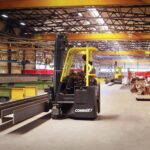
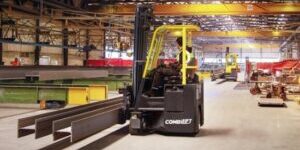
Multi-Directional Forklifts Multi-directional lifts are designed to handle long loads in tight quarters, eliminating the need for the forklift to rotate the load relative to the lift’s path of travel. Instead of turning the load with the lift, the lift’s tires themselves rotate, allowing the lift to drive down narrow aisles with the load parallel (not perpendicular) to the aisle. |
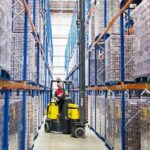
Articulating, Very Narrow Aisle Forklift Articulating lifts allow the lift’s forks to independently rotate to access goods while the lift’s cab stays relatively aligned with the drive aisle. Since these lifts do not need to swing the full length of the truck to square up with the load, aisle widths can be drastically reduced (down to 1.6 meters or about 5 foot 3 inches). |
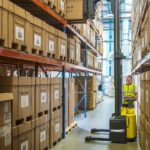
Pedestrian Stacker Based on the same principle as the articulating forklift described above, pedestrian stacker trucks are hand-driven by walking operators. Pedestrian stackers are economical solutions for smaller warehouses where higher product densities are desired but at lower volumes that don’t require a driven lift. |
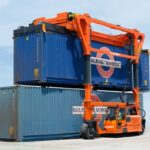
Straddle Carrier Bulk container applications have long been served by oversized forklifts and fixed gantry cranes, but now with straddle carrier vehicles, these load types can be much more easily handled. Straddle carriers can pick and place containers directly from freight trucks and can maneuver these containers down traffic lanes without the need for additional turning space. |
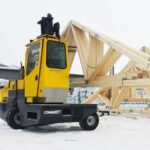
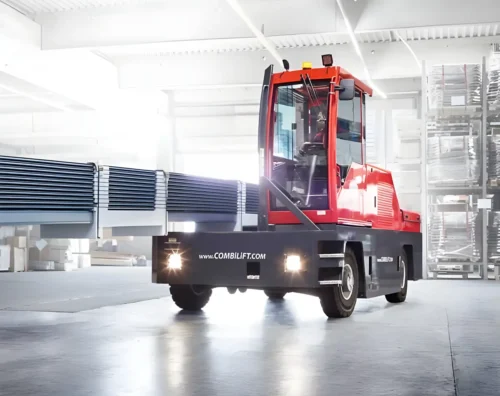
Side Loader Forklift Side loader lifts are another variant of the multidirectional lifts we introduced above, focusing on low-elevation truck and yard loading activities instead of high-reach storage racking placement. Side loaders are purpose-built for fast picking of materials, speedy shuttling across yards, and efficient placing of materials onto trucks or into yard bays. |
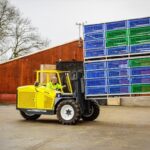
Agriculture / Livestock Forklift Many agricultural and livestock material handling applications fall within a unique intersection of load criteria: large, oversized, or oblong dimensions but at relatively low weights. This type of load calls for a special agricultural fork truck design that provides smooth, stable maneuvering without the need for massive counterbalances and power trains. |
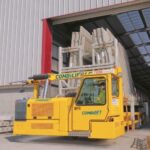
Load Carriers Load carriers are common in the building construction material industry for shuttling loads around between manufacturing stages and staging yards. These vehicles have hydraulically actuated lift decks that pick and place material racks quickly, offering faster, safer, and more stable load movements than with oversized forklifts. |
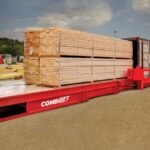
Container Loader While container loaders are not fork trucks, they are worth mentioning as they directly offset the need for other specialty fork trucks in the right applications. Container loaders are fixed equipment pieces that automatically end-load shipping containers with long, heavy materials, saving huge amounts of time compared to traditional push-and-slide forklift loading. |
Improving Warehouse Efficiency Using Specialty Lift Equipment
Specialty warehouse equipment helps improve overall warehouse efficiency in the following key ways:
- Optimized Warehouse Layout – a warehouse design based on specialty equipment – especially multidirectional forklifts – requires less traffic space, provides more storage space, and allows for less travel distance between work areas.
- Heightened Safety – specialty equipment is designed for fewer maneuvers, better visibility, and greater load stability even for the largest, longest, and heaviest loads. This translates into heightened employee safety as well as better product protection (which also equates to fewer product rejects and ensured quality).
- Improved CapEx Costs – when constructing a warehouse designed around specialty equipment, the CapEx budget can be more optimally distributed between floor area and fixed assets. That is to say, budgets can be split less towards construction costs and more towards revenue-generating equipment (specifically, more racking positions and more lifts).
- Reduced OpEx Costs – taking the above point one step further, specialty lift equipment directly provides lower operating costs, as pick missions are faster, and traffic congestion is reduced thanks to using equipment designed for fewer operating actions.
MH Equipment is one of the largest material dealers in the United States, with 34 servicing locations and over 1,000 employees serving customers in 10 upper Midwest and Eastern states. Our mission is to deliver exceptional service in material handling equipment sales, service, rental, certification & training, and engineering. From complete fleet management to warehouse design, vehicle sales to roadside response, our experts are here to serve your needs. For more information email us here.
Posted in New & Used Equipment, Warehouse
We are here to help.
Count on our friendly support team to provide the guidance you need. (614) 871-1571
