









Like what you see?
Solving Challenges with Fixed Warehouse Equipment Solutions
While every supply chain facility has its own unique challenges, the vast majority can be distilled down to just four overarching constraints: capacity, throughput, efficiency, and profitability. When we look through these operational lenses, we can quickly understand which business objectives need attention, and which engineered solutions might be most appropriate. Very often, the right solution to these constraints comes in the form of fixed equipment ̶ that is, immobile, permanently installed industrial warehouse systems designed to increase capacity, speed up throughput, improve efficiency, and bolster operational profitability. Let’s take a closer look at fixed warehouse equipment options below.
Fixed Warehouse Equipment Categories
Here we’ll outline key categories of fixed warehouse equipment and describe how each one benefits the four business metrics we mentioned above (capacity, throughput, efficiency, and profitability).
Industrial Storage Systems
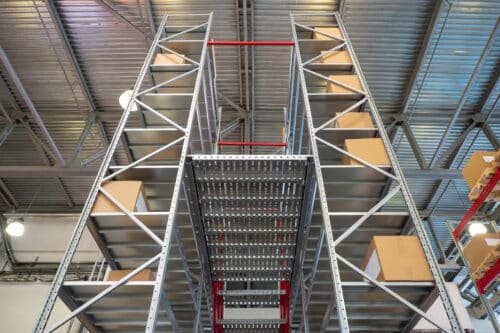
When warehouses experience capacity concerns, the solution typically comes in the form of an industrial storage system. Fixed storage systems directly influence how much product can be held in a fixed area by setting how closely materials are positioned, as well as how many layers are stacked vertically. Storage systems come in many forms, from simple static racking all the way up to extremely automated “operator-less” systems, and many options in between.
Examples of industrial storage systems include:
- Industrial Racking and Shelving
- Storage Mezzanines
- Bin and Slot Storage Systems
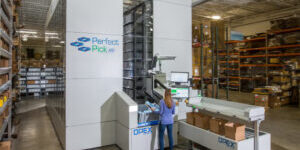
- Complete Automated Storage such as AS/RS (Retrieval Systems) and Goods-to-Person Systems
Material Conveyance
How many materials can move through a warehouse within a given timeframe is referred to as the warehouse’s throughput and is a key metric that warehouse managers track against an expected throughput rate. For example, a warehouse may expect a throughput of two hundred units per hour, or five thousand units per day. If the warehouse’s capacity falls beneath this expectation, a throughput constraint is present and requires attention.
Mechanized conveyance systems directly benefit throughput by moving materials quickly around a warehouse without tying up a human operator or forklift. More examples include:
- Powered Conveyors
- Gravity Flow Conveyors
- Pallet Elevators
- Accumulation Conveyors
Automated Unit Operation Systems
When warehouse managers think about efficiency, they usually weigh their staff headcount against total throughput – in other words, they compare how many people it takes to move an expected number of products per hour or per day. From another perspective, handling materials takes up space relative to the quantity of employees involved, so managers also compare how much warehouse area is needed to achieve a certain throughput.
Combining both elements, managers know that the more they can increase throughput with the same amount of people and area required (or less), the higher their efficiency. To address both variables, there is an entire world of fixed equipment solutions available that can automate individual work tasks at higher rates, smaller footprints, and with fewer operators. Examples include:
- Containerizing Equipment such as Baggers, Cartoners, and Sealers
- Marking Equipment such as Printers, Labelers, and Coders
- Material Prep Equipment such as Case Erectors, Bag Formers, and Pallet Wrappers
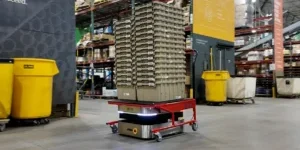
- Automated Vehicles such as AGVs (automatic guided vehicles) and AMRs (autonomous mobile robots)
Operational Technology Systems
Most fixed warehouse equipment solutions have an optional software counterpart intended to integrate physical activity with data analytics. In the industrial material handling market, these options are referred to as operational technology systems, which are coupled hardware and software packages specifically designed to mine deep, visceral operational data and extract conclusions that managers can immediately act upon. This depth of operational insight is best used to drive managerial improvements that ultimately lead to more effective, productive, and profitable warehouse operations.
Operational technology systems can serve any number of managerial support functions, from gathering data about forklift charging used to optimize charging schedules, to automatically generating an entire site’s daily missions and activities. Further, these systems tie multiple disparate elements of a business together in novel ways, such as with forklift telemetry systems that can report data on how well an individual operator performs different types of forklift actions, including their daily checklist for safe operation. Other examples include:
- Warehouse Management Systems (WMS)
- Warehouse Execution Systems (WES)
- Forklift Telematics
- Rapid Battery Charging Systems
Example Applications of Integrated Fixed Warehouse Equipment Solutions
While the above fixed warehouse equipment options are grouped separately to address individual warehouse constraints, multiple solutions are often deployed together. To showcase how different solutions can be integrated into a cohesive package that addresses compound business constraints, let’s review two mini case studies below.
- Demand Increase
- Goal: Meet Increasing Market Demand
- Challenge: Limited Capital, Landlocked Site
- Solution: High-Density Storage & Operational Technology Systems
- Summary: In this project, our client was a medium-sized manufacturer that shipped out of their own warehouse. The business was in need of increasing capacity to meet growing customer demands but had few options due to limited working capital and a site landlocked between other properties. After a thorough investigation, our team found that their current throughput was limited by poorly organized pallet racking and excessively long pick mission times. To improve both conditions, we modified their racking system to increase storage density in the same footprint (by swapping out half of their single selective racking for pushback racking) and deployed a light warehouse management software package to optimize mission paths and sequences. These improvements allowed for a 20% increase in daily throughput, exceeding their new demand requirements by a fair margin.
- Shrinking Profitability
- Goal: Restore Operating Profit Margins
- Challenge: Limited Labor Availability, Soaring Operating Costs
- Solution: Automated Unit Operations & Conveyance Systems
- Summary: For this project, we worked with a repeat client that was suffering from margin erosion driven by difficulties in staffing their warehouse. Our project engineering team performed a site audit and determined that introducing fixed warehouse equipment solutions would provide immediate relief. Fixed equipment options would ease constraints stemming from low workforce availability by both permanently decreasing the client’s necessary headcount as well as by converting manual jobs to higher skill roles. We installed several automated conveyor runs to eliminate the need to hand-carry products across the warehouse, and also provided unit operation equipment pieces to automate erecting, sealing, labeling, and coding cartons. About a dozen employees were retrained to operate these systems and perform more complex tasks in the warehouse that were previously understaffed, which altogether improved operating conditions and brought operating margins back within expectations.
MH Equipment is one of the largest material handling service providers in the United States, with 34 servicing locations and over 1,000 employees serving customers in 10 upper Midwest and Eastern states. Our mission is to deliver exceptional service in material handling equipment sales, service, rental, certification & training, emergency response, and engineering. From complete fleet management to warehouse design, vehicle sales to roadside response, our local experts are here to serve your needs. For more information email us here.
Posted in Warehouse
We are here to help.
Count on our friendly support team to provide the guidance you need. (614) 871-1571
