







Like what you see?
Breaking Down Industrial Cleaning Equipment Types: From Pressure Washers to Scrubbers
For industrial distribution, warehousing and manufacturing spaces, diligent cleaning is a surefire way to promote employee comfort, protect the quality of products being handled, and provide safe working environments free of accumulated soils and debris. To do so, warehouse and facility managers utilize all types of industrial cleaning equipment, each piece chosen for a targeted soil type, cleaning frequency, efficiency, and cost point. Below we’ll discuss cleaning equipment options, their available configurations, and key considerations for managing cleaning equipment.
Keeping warehouse spaces tidy can be broken down into three levels of effort:
- Normal Cleaning – industrial cleaning equipment most commonly fulfills the objective of routine cleaning, tidying up loose dust, debris, particulates, and soils that naturally accumulate in a material handling space through everyday use. Shipping and receiving docks tend to receive the most attention for routine cleaning, as do forklift traffic lanes where receiving activities track soil into the warehouse. If non-marking tires are not being used, tire marks are commonly found, especially along corners.
- Deep Cleaning – when soil builds up to levels that threaten safety, product quality, and customer satisfaction, it’s time to perform a deep cleaning. Warehouse spaces tend to receive deep cleaning between once a quarter and once a year, varying by how well their routine cleaning keeps up. Industrial equipment that targets deep cleaning is often more powerful than standard cleaning equipment, employing stronger chemicals and thermal treatments as well.
- Area Environment Quality – aside from common dust and debris, there is an entirely different set of soils that threatens the environmental quality of material handling spaces. Airborne allergens, volatile vapors, carcinogens, engine exhaust emissions, molds, and other biological soils can accumulate in warehouses by venting from stored products, flowing in through ventilation systems, or being pulled into the building through dock doors. Cleaning of these types of soils can be achieved using industrial equipment specifically outfitted for the job (such as with disinfection, irradiation, ultraviolet light, and HEPA filtration components).
As we can see, incidental and inconsistent cleaning is not enough to handle the needs of material handling spaces, which is where purpose-built industrial cleaning equipment comes into play.
Common Cleaning Equipment Types and Features
From routine cleaning to robust environmental quality improvement, there is a wide array of industrial cleaning equipment available on the market for material handling, general commercial, construction, and site maintenance applications, including:
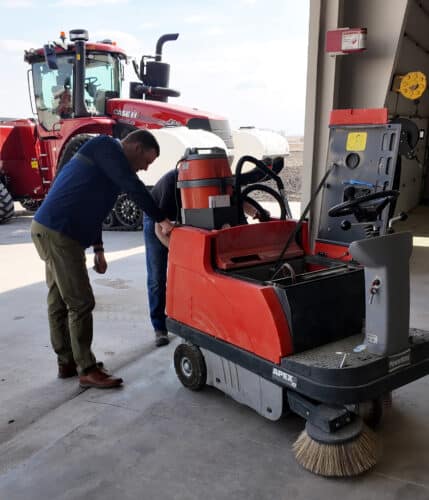
- Sweepers – sweeper equipment uses powered brushes with integral vacuum suction to dislodge and pick up loose particulates from open floor spaces. Sweepers typically only target general light cleaning activities, but can be equipped with many optional features such as dust control misters, high-capacity debris containers, and adjustable sweeper pressure forces.
- Scrubbers – scrubbers tackle hard-to-clean soils, spills, films, and deposits that cannot be effectively swept up. Scrubber equipment utilizes pressurized buffing and scrubbing pads mounted to high-force motorized heads that oscillate soils away. Hot and cold water, cleaning chemicals, and vacuum suction all work together to forcefully remove debris and can even apply heat to dry as well as ultraviolet light to sterilize the floor afterwards.
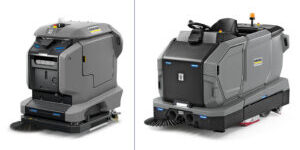
- Combo Cleaners – sweeping and scrubbing attachments are different, and one cannot reasonably perform the job of the other. Some applications require an equal balance of both cleaning functions, making a combo sweeper-scrubber cleaner equipped with both systems the ideal choice. On these combo cleaners, each cleaning system can be used independent of the other, or simultaneously if conditions warrant.
- Vacuums – industrial vacuum cleaners tend to come in mobile canister styles where humans operate suction wands, quite like residential vacuum wand attachments. These heavy-duty vacuums handle both wet and dry soils, including aggressive debris such as loose gravel and chemical powders. For large areas that do not require scrubbing to free up embedded dust from floors, larger area vacuums are available that resemble industrial sweepers but without the sweeping brushes.
- Pressure Washers – for the most aggressive cleaning needs, pressure washers utilize high-pressure, tightly targeted water jets to physically dislodge soils. Pressure washers for industrial applications usually operate between 500 PSI and 6,000 PSI, offering solutions that can break down the hardest, most engrained soils from resilient surfaces. In addition, pressure washers can be used with hot water and cleaning chemicals, adding to their cleaning potential.
- Central Cleaning Systems – when thinking about industrial cleaning equipment, readers tend to visualize mobile systems that need to be physically transported to work areas. In certain applications, mobile solutions are not practical, giving way to permanent stationary systems installed throughout a workspace instead. Central cleaning systems reside in a utility space and are piped out to work areas, supplying wash water, vacuum suction, and high-pressure sprays to hose drops mounted around the site.
- Chemical Dispensing Systems – for applications that require heavy chemical use to get the job done, dispensing chemicals near the points of use may be an attractive option. In material handling spaces, bulk chemicals are often stored in protected areas, making it cumbersome and slow to refill cleaning equipment. Instead, chemicals can be distributed out to strategic dispensing locations that will only dispense the small volumes needed to refill cleaning equipment and containers.
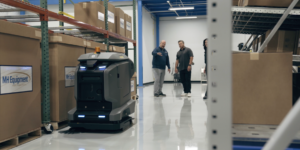
Sweepers, scrubbers, combo cleaners, and vacuums are readily available in either walking or riding variations. Walk-behind units are often used for smaller spaces that call for tight maneuvering and only incidental cleaning, whereas riding units are best for large spaces. Both styles can also be provided with semi-automatic and fully autonomous control systems, freeing up human operators to perform other critical duties. Note that even when used in fully autonomous mode, the equipment will almost certainly require supervision and possible intervention if cleaning paths need adjustment.
Maximizing the Benefits of Industrial Cleaning Equipment
Managing industrial cleaning needs is by nature straight forward – a cleaning task must be accomplished, and so a piece of cleaning equipment is selected to tackle that specific task. With that said, there are still plenty of nuances that can make or break any cleaning application, a few of which we’ll share below for warehouse managers to consider with their next cleaning equipment purchase:
- Equipment Functionality Selection – buyers often over-buy industrial cleaning equipment, purchasing options or models that offer many advanced features but are not ideal solutions for the buyer’s actual use-case. For example, many buyers purchase combo sweeper-scrubber units with the intent that they’ll utilize both functions, only to find out that they use one function so infrequently that they could have paid less for a single-function unit and rented the other when needed.
- Understanding Cleaning Limits – buyers should thoroughly review the capabilities, specifications, and technical limitations of the equipment they’re looking at to ensure that these are not overly restrictive. For example, the difference between a 2 mph and 3 mph rider-sweeper may seem trivial on paper, but this could translate into hundreds of working hours over the course of a year. Since technical specifications can be hard to interpret, we always recommend that buyers physically test new equipment at their facility to gauge its real limitations.
- Chemistry Makeup – for all industrial cleaning equipment that use chemicals, selecting the right chemistry makeup is imperative towards achieving the desired level of cleaning on a cost-effective basis. In many cases, buyers will be sold on chemical products that are either overly aggressive or entirely mismatched to their real goals (such as buying a caustic detergent when all that was needed was a light acid sanitizer). In addition, mismatched chemistries and excessive concentrations can cause physical damage to cleaning equipment as well as the surfaces that they clean.
- Routine Maintenance – practically by definition, cleaning equipment takes a beating and gets dirty itself in no time flat. Owners of industrial cleaning equipment must commit to proper maintenance, service, internal and external cleaning, and timely parts replacements as required by the equipment’s manufacturer. For aggressive applications, the manufacturer’s maintenance requirements may not be sufficient, requiring buyers to assess and perform necessary service as soon as it’s needed.
- Custom Equipment Solutions – when no pre-configured equipment solution solves a unique challenge, there is always the option to design and purchase custom equipment tailor-made to a given application. Most often, we see industrial cleaning equipment customized in areas such as cleaning head attachments, cleaning pressures, water tank volumes, heating temperatures, forced-air drying attachments, and even fully autonomous, self-driving navigation.
MH Equipment is one of the largest material handling service providers in the United States, with 30+ locations and over 1,000 employees serving customers in upper Midwest and Eastern states. Our mission is to deliver exceptional service in material handling equipment sales, service, rental, certification & training, emergency response, and engineering. From complete fleet management to warehouse design, vehicle sales to roadside response, our local experts are here to serve your needs. For more information or to discuss your application, please call us at (308) 210-7387 or email us here.
We are here to help.
Count on our friendly support team to provide the guidance you need. (614) 871-1571
