























Like what you see?
As June marks National Forklift Safety Month, we would like to share an informative blog post highlighting potential forklift hazards and outlining essential safety protocols to follow to keep you and your organization safe.
Examining Forklift Hazards in the Supply Chain
When it comes to safety management, business leaders must choose which one of two mindsets they’ll adopt for their organization – a proactive mindset or a reactive mindset. If asked, most leaders will identify themselves as having a proactive mindset, as the connotation of a reactive mindset sounds like waiting for accidents to happen before taking action. While this is sometimes the case, a reactive mindset more often manifests in less obvious ways such as overly minimizing operating budgets, intentionally delaying equipment repairs, or foregoing a full warehouse hazard analysis.
Every time a decision is made that turns away from a known risk, safety is left to chance. Nowhere else in a warehouse is this reactive mindset more dangerous than in the realm of forklift safety, where hazards can be just as numerous as they are probable to occur. For this reason, we encourage all business managers to thoroughly examine the many forklift hazards present in their warehouse, distribution, and manufacturing facilities, their root causes, and proactive solutions that can eliminate these hazards for good.
Common Forklift Accidents and Their Root Causes
Assessing forklift hazards in a warehouse begins with knowing what we’re looking for. While hazards can come in any form (many of which are specific to a given environment or application), the most common forklift safety hazards are universally identifiable, including:
| Hazard | Description | Common Causes |
| Forklift Tip-Overs | A forklift’s stability is precarious on account of its smaller footprint and large height-to-width ratio. A forklift is prone to tipping over onto its side anytime that its center of gravity shifts too far or too quickly away from the center of the lift’s mass.
|
– Abrupt turns at high speeds
– Uneven loads – Bound or caught loads – Turning on inclined surfaces |
| Equipment Impacts | Pallet racking, guardrails, delivery trucks, bollards, and even other forklifts are all examples of warehouse equipment that forklifts routinely impact. In many cases, these impacts lead to damage and larger safety hazards, such as when striking a primary racking column. | – Operator carelessness
– Operator inattention – Poor visibility – Traveling without a spotter |
| Pedestrian Impacts | Any spot in a warehouse where foot traffic and forklift traffic converge presents a potential recipe for disaster. Loading docks, charging stations, main entry doors, and traffic crossings are the most common areas for pedestrian accidents. | – Operator inattention
– Blind spots – Unmarked traffic lanes – Lack of traffic controls (such as stop signs and speed limits) |
| Uncontrolled Loads | Materials that are not firmly and positively constrained to a forklift (either directly or through a base pallet) are considered an uncontrolled load that can tip, slide, shift, or fall without warning. | – Failure to secure the load to the pallet
– Improperly lifting materials – Missing load backrest – Inadequate tie-downs |
| Uncontrolled Travel | Any time a forklift moves against an operator’s intentions is deemed to be uncontrolled travel. A free-moving forklift can impact nearby people, equipment, and materials, and due to its heavy weight and sharp forks, can do tremendous damage even at low speeds. | – Failure to set the parking brake
– Lift being dragged by load – Operator inattention – Equipment failure – Stunts attempted by the operator |
| Exposed Edge Forklift Falls | Unprotected docks, ramps, and truck bays pose a major fall risk to any forklift that travels nearby, as operators who do not see the open edge can drive right off the end and fall to the lower ground below. Seaside docks are especially dangerous, presenting both a fall and drowning risk. | – Unprotected dock edges
– Unmarked thresholds – Operator inattention – Wet floors – Wet weather |
| Personnel Falls | Forklifts are often used to lift personnel up to high elevations for inventory checks, maintenance, inspection, and repairs. To do so safely, a code-compliant man basket accessory must be used, and the basket must be positively tied off to the lift. | – Lack of man basket
– Improper man-basket use – Missing fall protection |
| Operator Errors | Many accidents can be drilled down to simple operator error, whether it be a moment of poor judgment or blatant disregard of safety policies. Either way, forklift operators are faced with countless safety decisions each day, and physiological factors such as rest, stress, mood, and underlying preoccupations can influence those decisions moment to moment. | – Inadequate training
– Distracted driving – Horseplay – Physiological Conditions |
| Emissions Exposure | Internal combustion forklift engines consume diesel, propane, gasoline, or natural gas and exhaust out gaseous combustion byproducts that can settle in confined areas. Similarly, lead-acid batteries emit toxic fumes while charging. In both cases, these emissions are harmful for humans to breathe and can also cause asphyxiation by displacing oxygen. | – Combustion engines
– Lead-acid battery fumes – Inadequate ventilation – Incorrect lift for the working environment |
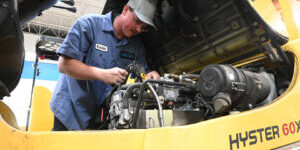
| Equipment Failures | As with any mechanized equipment, forklifts wear as they age, requiring ample maintenance to stay in good functioning order. In addition, aggressive environments and accidents can accelerate forklift failures. | – Inadequate maintenance
– Poor operating conditions – Operating outside of forklift’s specifications |
Key Solutions for Preventing Forklift Accidents
Since our goal is to promote a proactive safety mindset, below we’ll list out a broad range of solutions that are not solely specific to the hazards above, but are wide-reaching so that business leaders can pick and choose how they’ll apply these suggestions within their warehouses:
Personnel Solutions
If forklift operators are ill-advised of their role in assuring safety for themselves and those around them, no other solutions will fill that gap. Solutions in this category are oriented towards individual forklift operators, helping to improve their skill sets and foster accountability for safe forklift practices.
- Training – warehouse safety can only be built upon a solid foundation of knowledgeable, informed operators. Managers must provide detailed, engaging, and reoccurring training to all operators both as a matter of law as well as an ethical obligation to the wellbeing of their staff.
- Risk Familiarity – the more familiar an operator becomes with the risks they may encounter on the job, the more likely they will react in a safe manner. Even better, operators who are familiar with risk factors can help police the warehouse and take action to curtail any risk factors they see.
- Experience – practice makes perfect, and a core part of keeping operators safe is to provide hands-on training that will allow them to become accustomed to their assigned working environment, activities, and equipment.
Equipment Solutions
Just as operators must be properly trained for their assigned tasks, their equipment must also be properly configured for its anticipated activities.
- Daily Inspection – as required by OSHA, inspections must be performed on all forklift equipment each day before use. Managers are free to add their own requirements to this daily inspection as well, such as a safety quiz or hands-on skill practice session.
- Compatible Equipment Ratings – as with any industrial vehicle, forklifts and their attachments must be rated as fully compatible with the environments, operating conditions, load types, and duty cycles that they’ll serve.
- Technology Platforms – many automation solutions serve to enhance forklift functionality, augmenting operator decision-making, and integrating safety directly into the lift. Telematics, operator-assist systems, vision systems, geolocating systems, and collision-avoidance systems are just a few examples.
Operational Solutions
Now we turn our attention to warehouse operations management, where business leaders can truly demonstrate their commitment to a proactive safety mindset by implementing safety-oriented procedures and practices.
- Site-Wide Traffic Policies – just as city roads have speed limits, set traffic directions, vehicle limitations, and safety structures, material handling sites should also implement site-wide forklift policies to control and protect operators, pedestrians, and equipment.
- Floor and Traffic Markings – properly demarcating traffic lanes, speed limits, pedestrian crossings, and forklift-restricted areas on warehouse floors is an excellent way to communicate safety requirements.
- Safety-Driven Site Design – a warehouse site can inherently integrate safety within its very design, where traffic, storage, and work areas are located and oriented to each other in ways that maximally separate humans from forklifts entirely.
MH Equipment is one of the largest material handling service providers in the United States, with 34 servicing locations and over 1,000 employees serving customers in 10 upper Midwest and Eastern states. Our mission is to deliver exceptional service in material handling equipment sales, service, rental, certification & training, emergency response, and engineering. From complete fleet management to warehouse design, vehicle sales to roadside response, our local experts are here to serve your needs. For more information email us here.
We are here to help.
Count on our friendly support team to provide the guidance you need. (614) 871-1571
Related Posts