

















Like what you see?
Autonomous Mobile Robots: The Next Best Thing in Industrial Material Handling
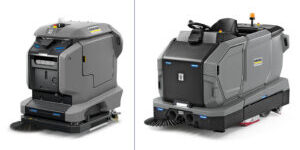
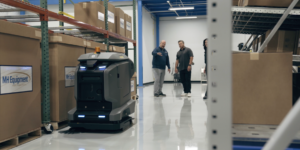
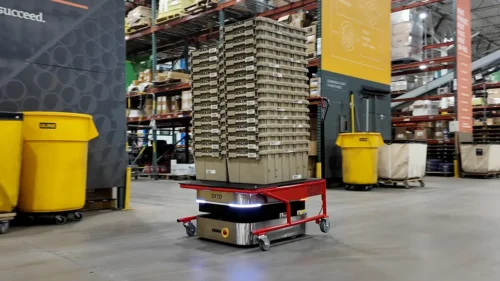
Autonomous Mobile Robots (AMRs) are automated material handling vehicles used to transport goods around a warehouse space without the need for a human operator. These robots can carry out tasks both simple and complex, from single out-and-back missions to compound set-and-sort routes running around the clock. AMRs are the next evolution of previous generation AGVs (automated guided vehicles), which were limited to predefined routes and frequent operator intervention whenever abnormal conditions were encountered. Today, AMRs offer a world free of these limitations, which also explains why AMRs are finding so much success in tackling historically manual workflows that fall between existing traditional automated warehouse systems. But before we get into application examples, let’s run through the main features of autonomous mobile robots:
- Independent Decision Making – autonomous mobile robots can make independent decisions about their routes, pick orders, and charging patterns using sophisticated algorithms and ongoing machine learning optimization.
- Advanced World Sensing & Mapping – to support their independent decision-making processes, AMRs build organic views of their operating environments using a host of onboard sensors and cameras.
- Real-Time Navigation – combining the above two points, AMRs can navigate through their environments autonomously, steering around obstacles, routing around traffic congestion, and minding safety rules all the while.
- Fleetwide Awareness – by design, AMRs communicate with each other, sharing data on their locations, statuses, and observed obstacles so that the overall fleet performs better. In addition, human-driven vehicles equipped with telematics interfaces can see the same information and coordinate their workflows to suit.
- Continuous Operation – since AMRs do not need human operators, an AMR fleet can operate continuously (even when individual AMRs cycle in and out of charging stations).
Why Businesses Integrate AMRs Into Their Existing Automated Warehouses
Now that we’ve reviewed the main features of AMRs above, let’s look at the most common goals (and application examples) that warehouse leaders target when deploying AMRs alongside existing automated warehouse systems:
- Offset Labor Shortages – traditional warehouse automation solutions favor bulk volume workflows to justify their costs, leaving lower volume workflows such as one-off pick missions or single container transports to human workers. For warehouses with bulk systems already in place, adding AMRs is a great way to automate these types of missions, freeing up precious labor for more complex tasks.
- Improve Safety – when we think about warehouse safety, we most often think about repetitive stacking tasks, heavy load handling, pedestrian and forklift conflicts, and all operations around truck docks. Many warehouses automate as much of these workflows as possible, but usually not in their entirety. AMRs offer new ways to further automate single tasks in these high-risk areas, as well as to eliminate the ergonomic burden of an employee carrying single containers long distances across a warehouse.
- Automate Accumulation – one of our favorite applications for AMRs is to automate accumulation staging between work centers. For example in manufacturing, many products must be manually transported from one work center to the next, and are often staged in racking bays until the downstream work center is ready. With AMRs, products can be automatically transported between work centers and floor staging zones.
- Increase Total Throughput – no matter how automated a warehouse currently is, there are always conditions where a little more throughput is needed. Since AMRs are “free range” – meaning that they can freely navigate around open warehouse spaces without the fixed guide wires or conveyors that other solutions require – they are ideal for adding capacity alongside existing systems.
- Improve Employee Care – certain applications benefit disproportionately with each employee that can be freed up using an automated solution, such as those in frozen, refrigerated, and high-risk environments. To directly improve employee welfare, AMRs can be deployed to remove employees from such hazardous conditions one at a time, and often at a lower cost than fixed automation such as cold-rated conveyors.
- Accommodate Future Growth – fully automated warehouses that use AS/RS and similar systems offer sensationally high capacities and bulk volume handling capabilities, but are at the same time very difficult to adapt to future growth outside of their initial design criteria. For example, if an AS/RS warehouse wished to offer less-than-pallet container volumes and rainbow pallet shipments, AMRs would be a great way to do so.
- Improve Quality & Warehouse KPIs – sometimes, warehouses just need a little flexibility to drive up their performance metrics where volume and/or legacy automation systems fall short. Many warehouses incorporate AMRs alongside their existing systems for just this reason, strategically replacing sources of human error, slow transit times, poor route consistency, product damage, and lost inventory with AMRs to great success.
Considerations for Successful AMR Deployments Alongside Existing Warehouse Automation
Each of the below considerations itself is a challenge in deploying autonomous mobile robots in existing warehouse environments, but with enough foresight on these points (and a little extra coffee), warehouse managers can set themselves up for success from the start.
- Selecting AMR Roles & Models – before anything else, warehouse managers must carefully consider what tasks and functions to automate with AMRs. Managers must perform extensive data analysis and forecasting of future business needs to determine what manufacturers, models, and quantities of AMRs will best fit the bill. This is a very challenging first step that requires detailed business process auditing, and many businesses stall out here without help.
- General Modernization – introducing AMRs into an existing warehouse starts with taking a long, hard look at the warehouse’s existing infrastructure. For most businesses, upgrades will be needed across IT, networking, power distribution (for charging), and fleet management systems, and these can be both complex and costly. However, once all the necessary infrastructure is modernized, the rest of the deployment will benefit from being built upon a stable foundation.
- Traffic & Material Flow – warehouses are designed in ways that typically maximize storage areas and minimize traffic areas, all connected by a very specific traffic plan. Introducing AMRs into this mix can call for moderate to substantial changes in these traffic flows, which in some cases even require rework to racking layouts and pedestrian routes. As new flow paths are developed to accommodate AMRs, overall traffic efficiency tends to increase (as does total volume capacity).
- Deployment Impacts – implementing AMRs will intrude into existing operations, and there will be an adoption curve that will take time before the AMRs reach their full potential. Managers must carefully plan installation schedules, cut-over outages, startup and training sessions, and decreased throughput periods while the new systems are rolled out.
- Personnel Training – speaking of training, businesses must provide plenty of training for all personnel who will be impacted by the new AMRs. Training naturally should involve all operators and supervisors, but also any other staff that will be exposed to AMRs during their work. In addition, businesses should prepare for some level of adoption push-back from resistant employees, and spend extra time training and familiarizing these folks until they are comfortable.
- Cost Controls – rolling out autonomous mobile robots can be a relatively costly endeavor that managers will need to be well prepared to control. Not only are investment dollars high to begin with, but potential large surprise costs can materialize without warning. To get ahead of cost movement, managers should perform extensive due diligence up front, identifying cost risks and planning contingencies well in advance. Specifically, managers should viscerally examine performance guarantees, warranty clauses, T&M exposure, and third-party fees (such as software licensing) before signing up with vendors.
MH Equipment is one of the largest material dealers in the United States, with 30 + locations and more than 1,100 employees serving customers in 10 upper Midwest and Eastern states. Our mission is to deliver exceptional service in material handling equipment sales, service, rental, certification & training, and engineering. From complete fleet management to warehouse design, vehicle sales to roadside response, our experts are here to serve your needs. For more information email us here.
Posted in Automation, Warehouse
We are here to help.
Count on our friendly support team to provide the guidance you need. (308) 382-3585
