


















Like what you see?
Strengthening Forklift Fleet Management with Telematics
While there is no way to have perfect visibility into every detail of a warehouse forklift fleet’s minute-by-minute activities, forklift telematics systems do get close. At a high level, telematics systems are electronic tracking and control systems integrated into forklifts (and other warehouse equipment) for the purpose of gathering data about how each lift performs. As this data is collected and analyzed, telematics systems can generate useful insights into the fleet’s overall health, efficacy, and risk factors which managers can act on further. In fact, telematics systems are often the ideal (if not only) hard data source for critical material handling management decisions that are otherwise made based on subjective observations and experience alone.
To help define forklift telematics systems, let’s point out their four primary functions:
- Data Acquisition – at their core, forklift telematics platforms provide a way to automatically capture data directly from a forklift in real time. When a telematics system is deployed, each forklift is outfitted with sensors and a digital user interface, all of which are then connected to a wireless communication network spanning the warehouse. These devices then communicate data to a local or remote server for further interaction.
- Operational Analytics – using the data captured from the lift’s sensors, the telematics system’s analytical platform then generates insightful information that managers can use to drive real operational improvements across their forklift fleet.
- Safety Reinforcement – safety is an ever-present concern for forklift fleet managers, and telematic systems provide a novel set of tools that directly help managers reinforce their safety footing.
- Policy Compliance – as a counterpart to safety reinforcement, telematics systems offer an interaction layer with each lift’s operators that serves to convey, confirm, and coach behavior in compliance with warehouse policies.
Key Functions & Benefits of Forklift Telematics
Before we dive into just how forklift telematics support managerial decision-making, let’s break down the main capabilities and types of data that telematics systems provide:
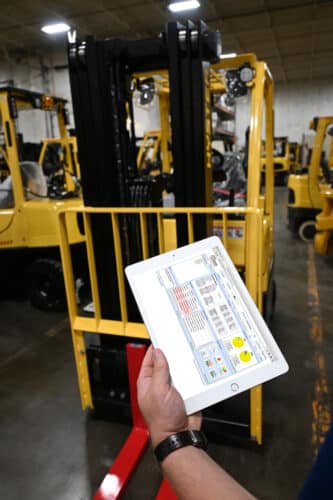
- Operator HUD – every telematics-enhanced forklift is equipped with a digital heads-up display (HUD) interface that operators can interact with. This display not only provides critical operating information to the operator, but also serves as the conduit through which key lift operating data is captured and sent back to the telematics’ analytic platform.
- Forklift Diagnostics – in addition to the HUD above, telematics-enabled forklifts are outfitted with a suite of sensors that act as the system’s eyes and ears. Through these sensors, the telematics engine can directly monitor the lift’s health and performance variables such as fuel efficiency, operating hours, charge rate, and trouble codes.
- Maintenance Logging – telematics HUDs facilitate the logging of maintenance and service work right on the lift, which can be pulled up locally at any time to confirm that a lift has been properly maintained. On top of this, maintenance logs entered on the HUB are reported back to a central data archive where they can be used for proactive maintenance planning and cost analysis.
- GPS Positioning – telematics systems provide locating services for all forklifts and equipment on which they’re installed, typically utilizing GPS positioning sensors (but also available with local mesh Wi-Fi network locating and similar options). Position tracking provides the foundation of analyzing route efficiencies, operator behavior factors, and much more.
- In-Situ Coaching – further on the note of operator behavior factors, telematic systems can provide interactive coaching and behavioral reinforcement right on the lift as the operator goes about their duties. Employees can benefit from explanations and infographics that supplement training presented on the HUD, and managers can benefit from instant detection and intervention of correctable behaviors (such as aggressive driving and excess speeds).
- Procedural Checklists – when it comes to warehouse forklift safety, OSHA is never far out of mind. In fact, telematics systems put OSHA and overall safety compliance front and center by requiring operator login, pre-shift checklist completion, periodic policy quizzes, and other procedural interactions conveniently on the lift. One of our favorite features is on-lift access to the company’s forklift knowledgebase where operators can look up procedures at any time.
- Utilization Tracking – telematics systems can track forklift usage patterns, mission performance metrics, and other productivity factors automatically. This data is essential for identifying areas for improvement as well as cutting under-utilization costs.
- Accident Detection – when accidents occur, the speed of notifications and the resulting responses can make all the difference to those involved. Telematics systems provide automatic accident detection and can send notifications instantaneously, even communicating with separate traffic control systems to reroute other vehicles away from the area.
Using Telematics to Inform Critical Operational Decisions
Practically all material handling organizations strive to do more with less, but only a portion of these businesses achieve this goal with lasting success. Making critical decisions about how a warehouse operates is never easy, though the businesses that do achieve success almost universally leverage extensive data to inform their decisions in the following ways:
- Utilization Management – the core managerial metrics of productivity and efficiency are directly derived from how well or poorly a business utilizes its resources (including forklifts). The data captured from telematics systems provides unprecedented insight into forklift utilization down to individual lifts and single mission legs. With this data in hand, managers can evaluate and augment working hours, staff counts, supplementary rental equipment needs, and much more from a fully informed position.
- Operational Efficiency – higher operational efficiency in material handling workflows often translates into less waste in terms of time, energy, and mistakes. When it comes to a forklift fleet, these sources of inefficiency are often difficult to detect and require either very tedious manual data gathering or the use of automated telematics systems. Once deployed, telematics data supports decisions such as shift durations, overtime uses, route profiles, product storage placements, racking designs, and even whole warehouse layout changes.
- Energy Optimization – material handling forklift energy consumption is not just about how much energy a lift consumes overall but also involves how fast that energy is consumed and how disruptive it is to replenish. A lift’s telematics system can provide valuable insight into all these factors, even tapping into compatible battery chargers and propane fueling stations for additional data. This data can help managers decide on changes to route distances, charging frequencies, equipment selection for different load weights, battery and charging technologies, and more.
- Behavior Normalizing – telematics systems capture data on lift operator behaviors which can be used to quantify risk factors and organization policy compliance across the entire workforce. This data is very useful in supporting staff management decisions such as training program contents and frequency, performance reviews and rewards, and adjustments to warehouse traffic rules. Even better, active behavioral reinforcement provided by a lift’s telematics HUD helps to positively normalize behavior between operators, especially when active forklift control interlocks enforce policies automatically (such as slowing a lift as it approaches crosswalks or limiting speeds in virtual “slow zones”).
MH Equipment is one of the largest material dealers in the United States, with 30 + locations and more than 1,100 employees serving customers in 10 upper Midwest and Eastern states. Our mission is to deliver exceptional service in material handling equipment sales, service, rental, certification & training, and engineering. From complete fleet management to warehouse design, vehicle sales to roadside response, our experts are here to serve your needs. For more information email us here.
We are here to help.
Count on our friendly support team to provide the guidance you need. (614) 871-1571
