



















Like what you see?
Addressing facility safety is about more than just following regulations; it is about building a culture where productivity and equipment reliability work together. Evaluating how your operation handles daily workflows and heavy lifting is essential to maintaining a competitive edge, especially during National Safety Awareness Month.
By prioritizing OSHA forklift regulations, reinforcing forklift operator training, and maintaining forklift compliance standards, facilities can reduce downtime, prevent accidents, and improve operational efficiency. Here are four ways to improve safety while keeping your operations running at peak performance.
1. Prioritize Daily Equipment Inspections
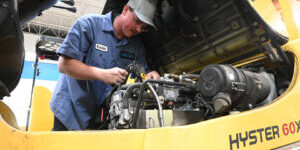
Facility safety starts before the equipment’s engine even starts. Implementing a consistent pre-shift inspection routine ensures that small mechanical issues are caught before they become hazardous failures. For teams managing a fleet, a formal forklift safety checklist is vital to comply with OSHA forklift regulations and overall equipment readiness.
- Check Fluid Levels: Ensure there are no leaks and that engines have proper oil and coolant levels.
- Tires and Brakes: Look for wear in tires and ensure brakes are responsive.
- Mast and Hydraulics: Inspect for frayed hoses or erratic movement in the lifting mechanism of all powered industrial trucks.
- Battery and Electrical Systems: Verify battery charge levels, cable condition, and warning lights before operation.
Routine inspections not only support OSHA 1910.178 compliance but also extend equipment lifespan and improve operational reliability.
2. Design Pedestrian-First Traffic Plans
In a busy warehouse, the intersection of foot traffic and moving machinery is the highest-risk zone. To reduce this risk, design your layout to physically separate the two whenever possible. Where foot traffic and equipment must cross paths, implement audio and visual alert systems to minimize danger.
To improve forklift safety throughout the facility:
- Floor Marking: Use high-visibility tape or paint to designate dedicated walkways.
- Blue Lights and Alarms: Ensure all mobile equipment is fitted with pedestrian warning lights that project a beam onto the floor, giving workers a visual alert.
- Clear Sightlines: Keep aisles, corners, and racking areas free from clutter to maximize visibility.
- Operator Assist Cameras: Utilize onboard camera systems to eliminate blind spots and provide a 360-degree view of the facility floor.
Well-designed traffic management plans support forklift compliance initiatives while creating a safer work environment for employees and operators alike.
3. Maintain Standards for Powered Industrial Trucks
While general facility safety covers the “where,” equipment standards cover the “how.” To remain compliant with OSHA forklift requirements, facilities must ensure their heavy machinery—specifically those categorized under OSHA 1910.178—is held to rigorous mechanical standards.
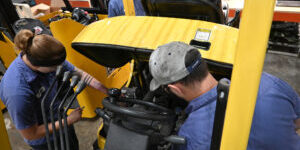
Waiting until a forklift breaks down can increase the risk of workplace injuries, costly downtime, and compliance violations. A proactive maintenance strategy helps facilities:
- Reduce unexpected equipment failures
- Improve operator confidence and equipment control
- Maintain steering, braking, and hydraulic performance
- Support ongoing forklift compliance efforts
When equipment is regularly serviced and inspected, operators can focus on forklift safety and productivity without worrying about equipment reliability.
4. Focused Staff Training and Evaluation
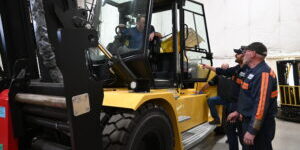
Even the most advanced safety features in the world cannot replace a well-trained team. National Safety Awareness Month is a great time to review your facility’s training program; comprehensive forklift operator training and general warehouse safety seminars are the backbone of a secure facility. Beyond initial certification, safety is maintained through constant attentiveness and regular refresher courses.
Important training topics include:
- Load Handling: Remind operators of the dangers of off-center loads and proper weight distribution.
- Speed Management: Enforce strict speed limits within the facility to reduce stopping distances.
- Environmental Awareness: Train drivers to account for floor conditions, such as dock plate gaps or wet spots, which can impact stability.
- Emergency Procedures: Preparing operators to respond quickly and safely to workplace incidents.
Consistent forklift operator training helps businesses stay aligned with OSHA forklift regulations while creating a culture of accountability and safety.
Protect Your People and Your Fleet
Improving safety is a continuous process, not just a focus during National Safety Awareness Month. By maintaining the health of your equipment and the clarity of your operational processes, you protect your team while ensuring productivity and operational efficiency.
Looking to improve your safety protocol?
Whether you are looking for a comprehensive maintenance audit or a complete review of your forklift compliance, contact a Safety Specialist today to take the steps that ensure a safer, more efficient tomorrow.
MH Equipment is one of the largest and most trusted material handling dealers in the United States, with over 30 locations and more than 1,100 employees serving customers across 10 states throughout the Midwest and East. We go beyond equipment; we deliver solutions that keep your operations moving. From forklift and fleet sales to responsive service, rentals, certification and training, and advanced engineered solutions, our team is committed to maximizing your uptime, safety, and efficiency. Whether you’re optimizing a single facility or managing a multi-site operation, MH Equipment is your dedicated partner every step of the way.
Ready to focus on safety and keep your operation moving smoothly? Contact an MH Safety Specialist today.
Other Safety Resources:
We are here to help.
Count on our friendly support team to provide the guidance you need. (814) 455-4455
