












Like what you see?
Renting Industrial Equipment ̶ A Case for Operational Efficiency
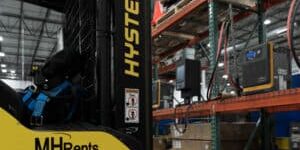
If we were to pick a single standout lesson about distribution business management that recent turbulent years have taught us, it would be that success can too often boil down to an organization’s flexibility. The need for flexibility can manifest in many ways – sometimes companies need to rapidly reduce overhead costs, diversify their product mix, respond to massive demand spikes, or pivot to secondary supply chains, all with little to no prior notice. The material handling sector is just as much impacted by this need for flexibility as any other. In particular, clients have been asking to reevaluate their equipment fleets in terms of cost effectiveness, which leads directly to a question: how can rental equipment help maximize operational efficiency? Let’s find out below!
We’ll begin by defining what we mean by operational efficiency in this context: we’re referring to the ability of an organization to put its operational resources – both assets and labor – to productive use, measured in financial terms. For example, in comparing two companies, if we say that Company A spends $0.90 to generate each revenue $1, and Company B spends $0.80 to generate each revenue $1, then Company B has higher operational efficiency because it can produce the same revenue dollar at a lower cost. Company B has deployed its resources more efficiently than Company A, and is making higher margins in return.
When it comes to industrial equipment, this relationship between internal costs spent on resources and the ability of that expenditure to generate revenue can be quite difficult to control. Buying a piece of equipment during market peaks just to have it sitting unused when markets cool down the next year would be a rather inefficient use of capital. On the other hand, renting a piece of equipment for months and years on end eventually exceeds the cost to just buy the equipment piece, also being an inefficient spend. The right choice is often in the middle – having a portion of one’s material handling equipment fleet directly owned, and scaling up capacity by temporarily renting additional equipment when the need arises. In this way, rental equipment is a surefire path to flexibility, and ultimately to high operational efficiency.
Benefits of Renting over Ownership
We covered the operational efficiency benefits of rental equipment above, but what other advantages might rental industrial equipment offer? The answer here lies first in understanding what equipment pieces are most practical to rent instead of own (and why).
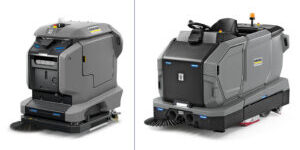
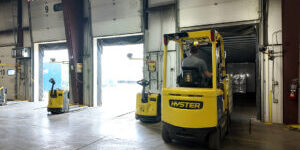
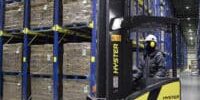
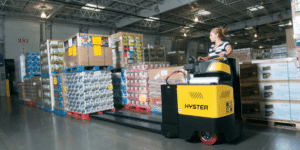
The most common rental equipment categories in material handling include forklifts, pallet jacks & movers, floor sweepers & scrubbers, floor vacuums, aerial lifts (such as scissor lifts and boom lifts), transport carts, and railcar movers. The reason that these pieces are the most commonly rented units in material handling is because they all perform a work task that tends to vary in demand – that is, these units are needed for temporary capacity spikes or bespoke projects and can be easily returned once the spike or project is over. In addition, these pieces are easy to transport, need limited specialized training to operate, and are rented at attractive prices compared to their full purchase price.
Additional benefits of renting equipment include:
- Low, short-term costs that can be classified as operating expenses.
- Avoids the asset price being added to the business’ books (and tax implications).
- Easy, reactive cost shedding to call off rental equipment as opposed to selling owned assets..
- Rapid capacity scaling by renting fewer or more units, often available within a few days..
- Provides easily acquirable redundancy and spare capacity, reacting to or protecting against existing equipment failures.
- Avoids maintenance, service, and parts costs, which typically would all be covered by the rental company.
- Provides near-new, modern equipment with low operating hours..
- Rental companies often provide additional value-added services such as training, coaching, delivery and pickup, and even unit recommendations best suited to the application..
- Avoids ancillary overhead costs such as additional maintenance staff, transportation insurance, and permanent storage facilities..
- All of the above factors drive increased operational efficiency by doing more work with fewer, lower fixed costs.
Balancing Total Costs and Rental Costs
With all of the great things above about rental equipment, why don’t material handling companies leverage more rental equipment than owned equipment by default? Some do, but of course there are plenty of benefits to ownership just as there are with renting. Keeping operational efficiency in mind, the trick here is to strike the right balance between rental units and owned units, and then to perpetually manage this balance over time.
We’ll briefly introduce three metrics that warehouse managers can use to evaluate their equipment fleet’s costs, in order to positively balance total and rental costs. Let’s use an example forklift fleet of 20 lifts to make the case.
A manager sits down to quantify their forklift fleet’s performance using utilization rate, productivity rate, and operating costs, reaching the below conclusions:
- Utilization Rate – this rate compares how many hours each lift is utilized out of the available productive hours. Our manager finds that 17 of their 20 lifts have good utilization rates over 85%, but the remaining 3 are underutilized at less than 40%.
- Productivity Rate – this rate describes how much productive work a lift (and its operator) can perform against an ideal target. Our manager finds that 16 of their lifts are operated at about 95% productivity, but 4 come in at lower productivity rates below 60%.
- Operating Costs – this metric compares the expenses involved with operating a lift over a given timeframe, divided by the hours that the lift is put to productive use. Our manager finds that 15 of their lifts have low operating costs per hour, but the remaining 5 lifts have hourly operating costs that are three times that of the other 15 lifts.
After digging into the above findings, our manager determines that their business can own and productively operate 15 lifts at a time. Due to business capacity variations, inconsistent labor availability, and high maintenance costs above a fleet size of 15 owned lifts, the extra 5 lifts are costing much more to own while providing minimal value. If the manager were just solving for one of the above three metrics, they might be driven to a different conclusion, but when looking at all factors together, our manager is led to a more holistic perspective. From this perspective, our manager decides that they can smooth out peak fluctuations to reduce the total necessary quantity of lifts from 20 to 18 lifts in the fleet. Now to balance costs, the manager decides to sell off the excess 5 units no longer needed to directly own, and to rent the incidental 3 lifts only during the days or weeks that they need the additional capacity.
By putting this plan in motion, our manager has successfully balanced the business’ total costs by leveraging rental forklift options to their advantage. With this reduction in total cost achieved, the manager has delivered improved total operational efficiency, stretching their expense dollars farther, and providing higher gross margin back to the business. Even better, the manager now has a quantitative system in place to monitor these costs moving forward, where rental industrial equipment can quickly be spun up or down to respond to capacity demands whenever the business needs.
MH Equipment is one of the largest material handling service providers in the United States, with 30+ locations and over 1100 employees serving customers in upper Mid-West and Eastern states. Our mission is to deliver exceptional service in material handling equipment sales, service, rental, certification & training, emergency response, and engineering. From complete fleet management to warehouse design, vehicle sales to roadside response, our local experts are here to serve your needs. For more information or to discuss your application, please call us at (308) 210-7387, visit our website here, or email us here.
Posted in New & Used Equipment, Rental
We are here to help.
Count on our friendly support team to provide the guidance you need. (614) 871-1571
