


















Like what you see?
Defining Optimization in Material Handling Warehouses
In one manner of speaking, warehousing can be distilled down to a few core functions: receive product in, store product until it’s needed, and when the time comes, ship that product out. Pretty simple, right? Maybe in concept, but at scale, we’re talking about daily activities involving hundreds of employees, thousands of material movements, and tens of thousands of stored product units – and that’s just on average. Likewise, orchestrating warehouse activity is complex to say the least, dealing with near-countless data points and composite tasks occurring in real-time as well as forecast out into the future. Balancing all of these demands is a major managerial undertaking, and once in motion, becomes the perpetual focus of attention looking to trade inefficiencies for productivity through continuous improvement. To this end, a good starting point in streamlining material handling center operations is found in optimizing your warehouse layout.
The layout of your warehouse influences your operational performance in a few different ways. First off, the physical construction of your warehouse sets the stage for all operations on your site, impacting everything from truck traffic congestion to future expansion options, so laying the site out properly with both today and tomorrow in mind is a major upfront endeavor. Second, the internal layout of your warehouse organizes people, materials, equipment, traffic lanes, and infrastructure in a strategic manner, driving attention to criteria such as travel times between areas, space allocations for storage, and safe execution of normal tasks. And third, singular layout details can have incredible bearing on operational efficiency, such as how wide to make forklift aisles and how deep to make deep pallet lanes.
Altogether, warehouse layout optimization and operational optimization can be considered one in the same. With this in mind, let’s next discuss specific business criteria to optimize a warehouse around, followed by ten warehouse layout features that can help achieve this optimized state.
Solve for the Right Criteria
Optimization can take on many forms, all specific to the facility, products, movement velocities, and operational nuances of the business at hand. Having a crystal-clear understanding of what specific concerns you’re trying to optimize around will make all the difference in selecting the most appropriate warehouse layout features. To help jumpstart that thought process, here are the most common optimization criteria we encounter:
- Total Capacity – optimizing for total unit volume often entails a very different warehouse layout than most other criteria, driving super high density over all other factors.
- Inventory Turnover – most warehouses have a spectrum of inventory turn rates, and poor positioning of high turn versus slow turn products can lead to low efficiencies or worse (we’ve seen facilities with high turn products laid out so far away from the docks, that forklift operators felt compelled to make unsafe decisions with their routes and speeds).
- Travel Distances – travel distances can have a large impact on warehouse throughput, staff productivity, and even equipment wear and tear. Over time, product mixes tend to change, and with them average travel distances.
- Headcount – optimizing headcount can take the form of reducing staff to cut operating expenses, stabilizing staff when candidate availability is limited, increasing headcount for seasonal peaks, or reallocating staff to balance business needs.
- Product Mix – physical and technical differences between products stored in a warehouse directly influence layout. For example, a building material supplier handling lumber and hardware will benefit from an entirely different layout than a cold storage distribution center handling frozen pallets.
- Quality and Accuracy – when product losses, damage, pick errors, and overall poor quality control are the primary concerns, warehouse layouts that encourage slower movement, higher managerial visibility, and broader material protection win out.
- Profitability – designing for profitability most often means solving for travel time and headcount, but it can also translate into other unique features such as extra space for opportunistic volume increases, or mixed modal infrastructure (i.e. railroad access) to tap into volume freight savings.
- Data – if you’re in e-commerce or similar scale distribution, data acquisition and integration may be your largest concern. This often drives layout decisions that support automation.
- Customer Satisfaction – real-time order status updates, food-grade clean conditions, third-party audit certification, will-call order pickup, and even facility tourability are a few aspects of customer satisfaction that can be valuable in your warehouse layout.
- Flexibility – finally, for warehouse owners who love options and want as few functional limitations as possible, laying out a warehouse with flexibility in mind may be the way to go. In the same vein, layouts based on providing flexibility typically also include provisions for ample future expansion.
Warehouse Layout Features that Maximize Optimization
Now that you have an idea of what business criteria you’re solving for, what most useful warehouse features can you choose from that will help achieve your goals? Keep in mind that most warehouses today will utilize multiple features below in unique ways depending on their particular needs, making the layout process one of balancing and prioritizing the business objectives above with the costs, tradeoffs, and value of the features below.
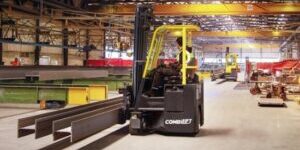
- Narrow Aisle Widths – this feature reduces the amount of floor space dedicated to walk and travel aisles, trading that space for more storage positions. For example, cutting normal 13′ wide forklift aisles down to 6′ wide aisles, combined with using narrow aisle turret lifts, can allow for significantly more floor positions across a warehouse.
- Build Up – adding product storage vertically provides a more efficient use of space, reducing travel distances and areas lost to traffic spaces compared to building out in length or width. In addition, building “up” is often more economical in construction costs, as less land and facility area is required.
- Centralized Services – considering employee productivity as well as infrastructure efficiency, centralizing warehouse services provides many benefits. Designing staff welfare areas such as break rooms, restrooms, and locker rooms central to their work zones cuts down on unnecessary travel and boosts job satisfaction. Central control rooms, utility equipment, and administrative offices further streamline warehouse operations.
- Centralized Docks – another way to cut down on unnecessary travel and improve workflow is to layout warehouses with centralized docks. One way to visualize this concept is to imagine getting trucks positioned in a way that they are equal distance to the most frequently used areas of your storage scheme, allowing forklift traffic to and from trucks to be on average as minimal and consistent as possible.
- Coordinated Traffic Lanes – some material handling centers will standardize on “clockwise only” or “left-hand turn only” traffic patterns, to minimize traffic bottlenecks and congestion. We like to design such standards into our warehouse layouts from the beginning, and to reinforce these standards through also providing coordinated, dedicated traffic lanes, which together maximize productive forklift travel.
- Cross Traffic Tunnels – especially for mixed order, pick-and-pack, and very high SKU count operations where lifts need to travel to disparate locations often, laying out a warehouse with sufficient cross tunnels helps forklifts get to where they need to be directly. Cross Tunnels are lanes that run perpendicular to main forklift aisles, cutting “through” racking by opening up vestibules positioned towards the center of long rack rows. Forklifts can quickly take these tunnels to get to adjacent aisles without having to drive to the end of the lane.
- Dedicated Pick and Pack Spaces – in certain applications, placing many small, dedicated workspaces around the warehouse can prove more efficient than requiring all goods be brought to a single, far-off work space. These spaces are very useful for breaking down incoming orders, building outgoing orders, and sorting partial counts out of bulk volumes right near where the materials are stored.
- Flow and Zones – for warehouses that utilize specific inventory turnover methods such as FIFO (First In First Out) or FILO (First In Last Out) schemes, specific layout, design, and equipment selections can pay off in spades. For FIFO, flow racking arranged as natural separators between inbound and outbound docks saves substantial handling effort. For FILO, deep lane racking laid out in large, dense modules maximizes space efficiency.
- Mezzanines – warehouses that utilize shelving, low-height racking, and manual picking can benefit immensely from mezzanine additions. These large structural platforms allow for building vertically into unused building height by essentially adding building floor levels, providing additional, efficient storage at elevations that humans can still safely access without lift equipment.
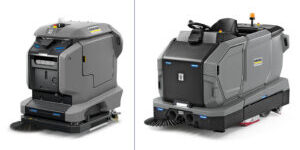
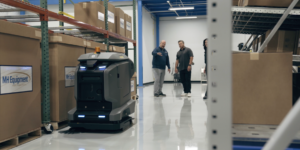
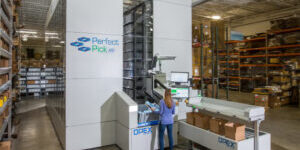
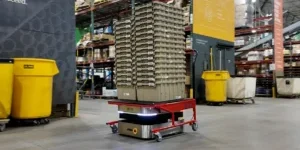
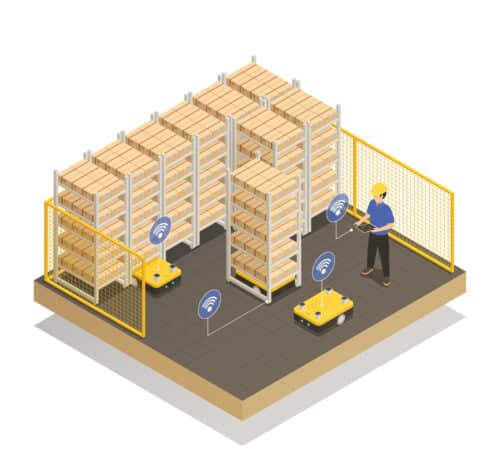
- Automated Storage – the pinnacle of warehouse layout optimization is found in automated technologies. Autonomous robotic equipment, advanced control software, predictive management systems, and automatic material conveyance machinery are examples of solutions that allow warehouses to operate smoother, faster, longer, safer, and more accurately.
MH Equipment is one of the largest material handling service providers in the United States, with 30+ locations and over 900 employees serving customers in upper Mid-West and Eastern states. Our mission is to deliver exceptional service in material handling equipment sales, service, rental, certification & training, emergency response, and engineering. From complete fleet management to warehouse design, vehicle sales to roadside response, our local experts are here to serve your needs. For more information or to discuss your application, please call us at (308) 210-7387, visit our website here, or email us here.
Posted in Warehouse
We are here to help.
Count on our friendly support team to provide the guidance you need. (614) 871-1571
